Table of Contents
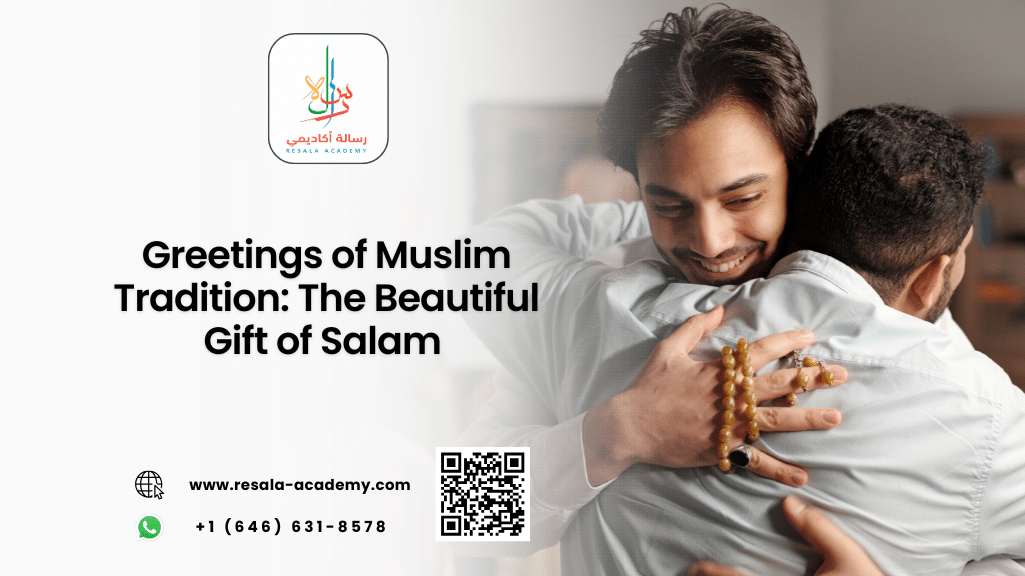
Greetings of Muslim Tradition: The Beautiful Gift of Salam
Step into any mosque from Houston to Kuala Lumpur, and before you hear a single verse of the Quran, you will hear the same two words: As-salamu alaykum. The greetings of Muslim communities everywhere begin with peace — a deliberate, prophetic choice that has bound believers together across fourteen centuries, hundreds of languages, and every culture on earth.
Yet many non-Arabic speakers repeat this phrase daily without fully grasping its depth, its rulings, or the gentle etiquette the Prophet Muhammad ﷺ attached to it. If you have ever wondered what the words truly mean, how to reply correctly, or why scholars call the salam “the right of every Muslim upon another,” this guide walks you through all of it — with evidence from the Quran and authentic Sunnah.
And if uncovering the meaning behind one Arabic phrase sparks a desire to understand more, that is exactly where structured learning begins. You can browse all Quran and Arabic courses at Resala Academy whenever you are ready to turn curiosity into comprehension.
What Is the Muslim Greeting of Peace?
Before etiquette comes meaning. Here is what the salam actually says — and why it is unlike any greeting in the world.
The Meaning of As-Salamu Alaykum
The full Muslim greeting of peace is:
السَّلَامُ عَلَيْكُمْ وَرَحْمَةُ اللَّهِ وَبَرَكَاتُهُ
As-salāmu ʿalaykum wa raḥmatullāhi wa barakātuh — “Peace be upon you, and the mercy of Allah, and His blessings.”
The word salām means peace, safety, and freedom from harm. It is also derived from As-Salām, one of the beautiful names of Allah. So when you greet someone, you are not saying a casual “hello” — you are making a du’a (supplication), asking Allah Himself to shield the person in front of you.
A Greeting as Old as Humanity
According to an authentic hadith in Sahih al-Bukhari 6227, when Allah created Adam (peace be upon him), He commanded him to greet a group of angels and listen to their reply, for it would be his greeting and the greeting of his descendants:
فَقَالَ: السَّلَامُ عَلَيْكُمْ، فَقَالُوا: السَّلَامُ عَلَيْكَ وَرَحْمَةُ اللَّهِ
Adam said, “Peace be upon you,” and the angels responded, “Peace be upon you, and the mercy of Allah” — adding to his greeting.
Two lessons stand out for every learner. First, the salam predates every nation and language; it belongs to all of humanity. Second, even the angels modeled the etiquette of replying with something better, a principle the Quran would later make explicit.
The Muslim Way of Greeting: Words, Replies, and Rewards
The muslim way of greeting has levels, a required response, and real reward attached to every syllable.
Three Levels, Three Rewards
A man once greeted the Prophet ﷺ with the short form of salam, another added Allah’s mercy, and a third added His blessings. The Prophet ﷺ responded in turn: “Ten… twenty… thirty,” referring to the good deeds each earned — a hadith recorded in Sunan Abi Dawud 5195.
| Greeting (Arabic) | Transliteration | Meaning | Reward |
|---|---|---|---|
| السَّلَامُ عَلَيْكُمْ | As-salāmu ʿalaykum | Peace be upon you | 10 good deeds |
| + وَرَحْمَةُ اللَّهِ | wa raḥmatullāh | …and the mercy of Allah | 20 good deeds |
| + وَبَرَكَاتُهُ | wa barakātuh | …and His blessings | 30 good deeds |
How to Reply: The Quranic Standard
Allah sets the standard for responding in the Quran:
وَإِذَا حُيِّيتُم بِتَحِيَّةٍۢ فَحَيُّوا۟ بِأَحْسَنَ مِنْهَآ أَوْ رُدُّوهَآ ۗ
“And when you are greeted with a greeting, greet [in return] with one better than it or [at least] return it [in a like manner].” — Quran 4:86
In practice: if someone says As-salāmu ʿalaykum, reply وَعَلَيْكُمُ السَّلَامُ وَرَحْمَةُ اللَّهِ (Wa ʿalaykumu s-salāmu wa raḥmatullāh) — matching their greeting and adding to it, exactly as the angels did with Adam. Scholars of Ahl as-Sunnah agree that initiating the salam is an emphasized Sunnah, while returning it is an obligation; if one person in a group replies, it suffices for all.
Saying It Right: Pronunciation Notes for Non-Native Speakers
Two small details transform an approximate greeting into an accurate one:
- The letter ʿayn (ع) in ʿalaykum is a deep, throat-based sound with no English equivalent. Saying a plain “a” (alaykum) is understandable, but training the ʿayn is one of the first victories in Quranic pronunciation.
- The hidden assimilation in As-salām: the definite article ال (al-) merges into the “sun letter” س, so we say as-salām, never al-salām. The doubling is marked in Arabic script by a shaddah ( ّ ).
These are precisely the details covered in Tajweed — the rules governing proper Quran recitation. Because every tutor at Resala Academy is a native Arabic-speaking Egyptian trained in Quranic instruction, learners get instant, gentle correction in live one-on-one sessions; you can meet the native Egyptian instructors at Resala Academy to see how personalized that feedback is.
Greetings of Muslim Communities: Etiquette for Every Situation
The Prophet ﷺ left detailed, practical guidance on who greets first, when, and where. The greetings of Muslim daily life follow a beautiful order.
Who Greets First? The Sunnah Order
The Prophet ﷺ taught in Sahih al-Bukhari 6231:
يُسَلِّمُ الصَّغِيرُ عَلَى الْكَبِيرِ، وَالْمَارُّ عَلَى الْقَاعِدِ، وَالْقَلِيلُ عَلَى الْكَثِيرِ
“The younger should greet the elder, the passerby the one sitting, and the few the many.” A related narration (Sahih al-Bukhari 6232) adds that the rider greets the one walking.
| Situation | Who initiates the salam |
|---|---|
| Riding vs. walking | The rider greets first |
| Walking vs. sitting | The walker greets first |
| Small group vs. large group | The few greet the many |
| Younger vs. elder | The younger greets first |
The exchange itself follows a simple flow: salam offered → reply equal or better → both parties rewarded → hearts drawn together.
When and Where to Offer Salam
The Quran even attaches the greeting to entering homes:
فَإِذَا دَخَلْتُم بُيُوتًا فَسَلِّمُوا عَلَىٰ أَنفُسِكُمْ تَحِيَّةً مِّنْ عِندِ اللَّهِ مُبَارَكَةً طَيِّبَةً
“…give greetings of peace upon each other – a greeting from Allah, blessed and good.” — Quran 24:61
Notice the phrase “a greeting from Allah”: the salam is described as coming from Him, blessed and pure. That is why Muslims say it when entering a house (even their own), when joining or leaving a gathering, at the start of phone calls, and in the opening line of texts and emails.
Spreading Salam: The Path the Prophet ﷺ Connected to Paradise
In Sahih Muslim 54, the Prophet ﷺ said:
لَا تَدْخُلُونَ الْجَنَّةَ حَتَّى تُؤْمِنُوا، وَلَا تُؤْمِنُوا حَتَّى تَحَابُّوا، أَوَلَا أَدُلُّكُمْ عَلَى شَيْءٍ إِذَا فَعَلْتُمُوهُ تَحَابَبْتُمْ؟ أَفْشُوا السَّلَامَ بَيْنَكُمْ
“You will not enter Paradise until you believe, and you will not believe until you love one another. Shall I not tell you of something which, if you do it, you will love one another? Spread salam amongst yourselves.”
Read the chain backward and its weight becomes clear: Paradise requires faith, faith is completed by mutual love, and love is cultivated by the salam — offered generously, to those you know and those you do not.
Read more about: Ameen in Arabic: Meaning, Spelling, and When to Say It
From One Phrase to the Language of the Quran
A single greeting can become your doorway into Arabic itself. Here is why.
One Root, Three Words: Salam, Islam, Muslim
Arabic builds families of meaning from three-letter roots. The root س – ل – م (s-l-m) produces:
- سَلَام (salām) — peace and safety
- إِسْلَام (Islām) — submission to Allah, which brings that peace
- مُسْلِم (Muslim) — the one who submits and lives in that peace
In other words, every time you say the greeting, you are pronouncing the very root of your faith’s name. This is the kind of insight that transforms memorized phrases into living understanding — and it is only the first of thousands of roots waiting in the Quran.
From Memorizing Phrases to Real Understanding
A realistic learning path looks like this:
- First, master pronunciation and the Arabic letters;
- Second, build vocabulary through roots like s-l-m;
- Third, study grammar and translation until Quranic verses open up on their own.
Resala Academy structures its Quran, Tajweed, Arabic, and Islamic courses around exactly this progression, with a certificate of completion for every level, flexible scheduling across time zones, and five-star student ratings on Trustpilot and Google — a track record built by teaching non-Arabic speakers around the world.
Let Your Salam Open the Door to the Quran
You have just studied one phrase in depth — imagine studying the entire Book this way, with a patient teacher beside you.
Learners who are new to Arabic succeed here because the environment is built for them:
- Native Egyptian tutors who correct your ʿayn, your shaddah, and your Tajweed in real time
- One-on-one classes that move at your pace — for kids, adults, complete beginners, and reverts
- Female tutors available for ladies who prefer a comfortable, private setting
- Flexible scheduling across the USA, UK, and worldwide time zones
- Affordable pricing and a professional certificate for each completed level
There is no obligation and nothing to lose: simply book your free trial class today and greet your first tutor with a confident As-salāmu ʿalaykum.
Frequently Asked Questions
1. What is the correct reply to As-salamu alaykum?
Reply with Wa ʿalaykumu s-salām (“and upon you be peace”) at minimum, and ideally add wa raḥmatullāhi wa barakātuh. The Quran (4:86) instructs Muslims to return a greeting with its equal or something better, and scholars consider replying an obligation.
2. Is the Muslim greeting of peace difficult for beginners to pronounce?
Not at all — it is usually the first phrase new learners master. The only tricky sound is the letter ʿayn (ع), and with a native tutor modeling it live, most students pronounce it correctly within a few sessions.
3. How are online classes at Resala Academy conducted?
Classes run as live, one-on-one video sessions with native Arabic-speaking tutors, so you receive individual attention rather than a recorded lecture. Scheduling is flexible around your time zone, and a free trial lets you experience a session before committing.
4. How do I move beyond memorized greetings to understanding Quranic Arabic?
Follow a structured sequence: pronunciation first, then root-based vocabulary, then grammar and guided translation of verses. Quran translation classes are designed for exactly this transition, taking you from what the words are to why they are chosen.
5. How can I stay consistent when learning Quran and Arabic online?
Fix a regular weekly schedule, set small goals (one surah, one grammar rule, one du’a at a time), and let your tutor hold you accountable. Earning a certificate at each level also gives you visible milestones — and renewing your intention (niyyah) keeps the effort an act of worship, not a chore.
A Greeting That Carries a Whole Faith
The salam is a du’a, a Sunnah, a social contract, and a promise of Paradise folded into a few syllables. From Adam’s first exchange with the angels to the Quran’s command to answer every greeting with something better, the greetings of Muslim tradition teach one lesson above all: peace is meant to be spread, deliberately and generously.
Let that phrase be the first Arabic you truly understand rather than merely repeat. With native tutors, flexible one-on-one classes, and a clear path from your first As-salāmu ʿalaykum to reading the Quran itself, Resala Academy is ready to walk that journey with you — starting with a warm greeting of peace.