Table of Contents
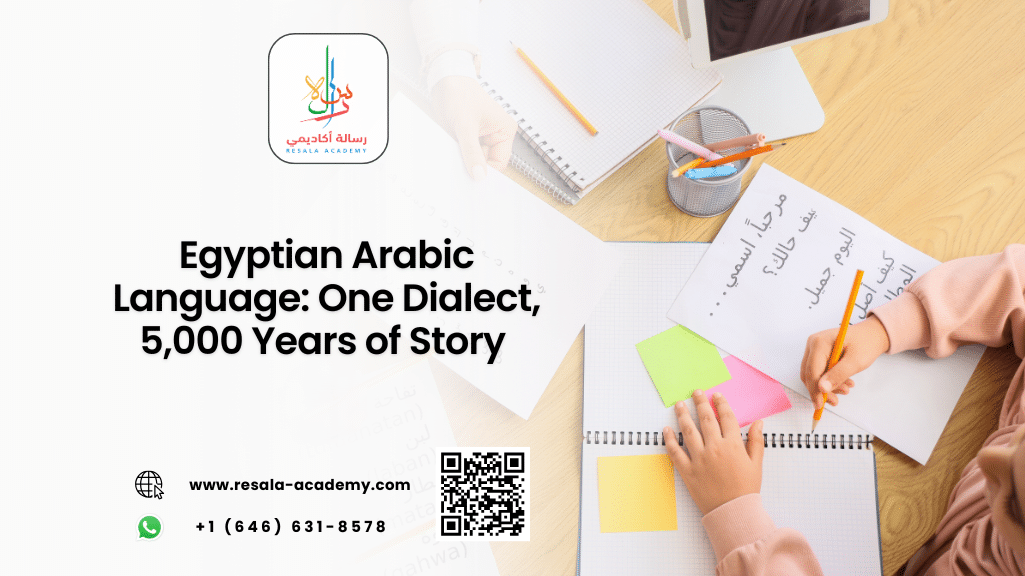
Egyptian Arabic Language: One Dialect, 5,000 Years of Story
Play any classic Cairo film and listen closely. The words rush past faster than your textbook ever promised, the letter ج sounds like “g,” and half the phrases appear in no standard dictionary. If you’ve ever wondered whether the Egyptian Arabic language is really Arabic at all — or something far older wearing Arabic clothes — you’re asking a question linguists genuinely enjoy answering.
The short version: Egyptian Arabic is very much a variety of Arabic, yet it carries echoes of a language Egyptians spoke for millennia before a single Arabic word reached the Nile. Knowing that layered story doesn’t just satisfy curiosity; it makes you a sharper, more motivated learner.
This guide walks through what Egyptians spoke before Arabic, how Egyptian speech differs from the standard language, how to greet someone like a true Cairene, and a realistic path toward fluency.
And when you’re ready to move from reading about the language to actually speaking it, the native Egyptian tutors at Resala Academy teach learners worldwide through live, one-on-one online classes — you can explore all the Arabic and Quran courses in one place.
Is Egyptian and Arabic the Same Language?
It depends entirely on which “Egyptian” you mean — the answer changes across five millennia.
Two very different meanings of “Egyptian”
When people search is Egyptian language Arabic, they’re usually blending two ideas into one. Modern Egyptians speak Masri (مصري — literally “Egyptian”), a spoken variety of Arabic. So yes: what you hear on Cairo’s streets today is Arabic.
The Ancient Egyptian language of the pharaohs is another matter. It belonged to a separate branch of the Afro-Asiatic family — related to Arabic roughly the way English relates to Persian: distant cousins within one family, never siblings.
The precise answer
- Egyptian Arabic is Arabic. It shares the core grammar, root system, and vocabulary of the wider Arabic language, with its own pronunciation and expressions.
- Ancient Egyptian is not Arabic. Hieroglyphic Egyptian and its descendants form their own branch, though the two languages later left fingerprints on each other.
- Masri is the Arab world’s “media dialect.” A century of Egyptian cinema, television, and song made it arguably the most widely understood spoken Arabic anywhere — and with Egypt’s population well past 100 million, you’ll never lack conversation partners.
The Egyptian Language Before Arabic
Long before Arabic reached the Nile, Egypt already possessed one of the longest written records of any human language.
From hieroglyphs to Coptic
The Egyptian language before Arabic was simply called Egyptian. First carved as hieroglyphs more than 5,000 years ago, it evolved through distinct stages over the centuries. Its final form, Coptic, traded hieroglyphs for a Greek-based alphabet with a few extra letters, and it was the everyday speech of Egypt when Arab armies arrived between 639 and 642 CE.
Old Egyptian → Middle Egyptian → Late Egyptian → Demotic → Coptic → Egyptian Arabic (today)
Each arrow above represents centuries of gradual change — never a sudden replacement.
How Arabic became Egypt’s mother tongue
Arabic did not erase Coptic overnight. It spread slowly through administration, trade, and conversion, while Coptic retreated first into homes, then into churches. Today Coptic survives as the liturgical language of the Coptic Orthodox Church — chanted in prayer, though no longer chatted over coffee.
Coptic fingerprints in today’s speech
The older language never fully vanished; it seeped into Egyptian Arabic itself. Linguists trace several familiar words back to Coptic roots:
- تمساح — timsāḥ — “crocodile”: a pharaonic creature that kept its ancient name and passed it into wider Arabic.
- واحة — wāḥa — “oasis”: traced to Coptic ouahe, describing Egypt’s islands of green in the desert.
- Coptic month names such as طوبة (Ṭūba) and أمشير (Amshīr) still guide Egyptian farmers and flavor weather proverbs today.
Egyptian Language vs Arabic: What Actually Differs Today
The modern comparison is really Egyptian dialect versus Fusha (الفصحى — Modern Standard Arabic), the formal register of news, books, and the Quran.
A tale of two registers
Arabic lives in a condition linguists call diglossia: one community, two registers. Egyptians read, write, and pray in Fusha, but they joke, bargain, and fall in love in Masri. Neither replaces the other — educated speakers glide between both, sometimes mid-sentence.
Sounds that give Cairo away
Three pronunciation shifts will instantly tune your ear to Egypt:
- ج becomes “g”: جميل (“beautiful”) is jamīl in Fusha but gamīl in Cairo.
- ق becomes a glottal stop: قلب (“heart”) shifts from qalb to ‘alb — that little catch you make in “uh-oh.”
- ث and ذ simplify: ثلاثة (“three”) is pronounced talāta, and ذهب (“gold”) becomes dahab.
Grammar that travels lighter
Egyptian Arabic streamlines several structures that beginners find heavy in Fusha:
- Present verbs take a b- prefix: بحب — baḥebb — “I love / I like.”
- The future takes ha-: هكلم — hakallim — “I will call / speak to.”
- Negation uses mish: مش عارف — mish ‘āref — “I don’t know.”
- Question words often sit at the end: رايح فين؟ — rāyeḥ fēn? — literally “going where?”
A side-by-side snapshot
| English | Fusha (MSA) | Egyptian Arabic | What changed |
|---|---|---|---|
| What’s your name? | ما اسمك؟ mā ismuk? | اسمك إيه؟ ismak ēh? | question word moves to the end |
| How? | كيف؟ kayfa? | إزاي؟ izzāy? | entirely different word |
| I don’t know | لا أعرف lā aʿrif | مش عارف mish ‘āref | mish negation |
| Beautiful | جميل jamīl | جميل gamīl | ج pronounced “g” |
| I want | أريد urīd | عايز ‘āyez | new everyday verb |
Read more about: Arabic Alphabet to English Alphabet: Full Chart & Guide
Hello in Egyptian Arabic Language: Greetings That Open Doors
Egyptians reward even a clumsy greeting with disproportionate warmth — so this is exactly where to begin.
From respectful to playful
| Arabic | Say it | Meaning | When to use it |
|---|---|---|---|
| السلام عليكم | as-salāmu ʿalaykum | Peace be upon you | Universal, respectful opener |
| أهلاً | ahlan | Hello / hi | Anytime, with anyone |
| صباح الخير | ṣabāḥ el-khēr | Good morning | Mornings — expect a poetic reply |
| إزيك؟ | izzayyak (to a man) / izzayyik (to a woman) | How are you? | Friendly, everyday |
| عامل إيه؟ | ʿāmel ēh? (m) / ʿamla ēh? (f) | How’s it going? | Casual check-in |
The jasmine reply
Here is a detail no phrasebook explains well. Answer صباح الخير with صباح الفل — ṣabāḥ el-full — “a morning of jasmine.”
Egyptians escalate morning greetings with flowers and light (ṣabāḥ en-nūr, “a morning of light”), and returning a greeting more beautifully than you received it is everyday etiquette — pure Egypt in a single phrase.
Two habits worth building early: match the gender ending (-ak for a man, -ik for a woman), and keep a graceful all-purpose reply ready — كويس، الحمد لله — kwayyes, il-ḥamdu lillāh — “good, praise God.”
Read more about: Greetings of Muslim Tradition: The Beautiful Gift of Salam
Egyptian Arabic Language Learning: A Path That Works
The dialect-versus-Fusha debate has a practical resolution: sequence them — don’t choose between them.
Fusha first, dialect first, or both together?
If your goals include reading, Quranic study, or academics, anchor yourself in Fusha and let Egyptian Arabic ride alongside for conversation. If your goal is chatting with Egyptians next month, lead with the dialect and backfill the standard language later.
Native Egyptian teachers move between both worlds effortlessly, which is why learning from them closes the gap between classroom Arabic and street Arabic.
At Resala Academy, every instructor is a native Egyptian Arabic speaker, so structured Fusha lessons arrive naturally seasoned with living pronunciation and cultural context — you can see how the academy’s native Egyptian tutors teach before committing to anything.
A four-step starter plan
- Master the sounds first. Learn the alphabet alongside Egyptian values of ج and ق from day one, so Cairo’s speech never sounds foreign later.
- Build a 100-phrase survival kit. Greetings, numbers, courtesy phrases, and the mish negation cover a surprising share of daily talk.
- Immerse through Egypt’s media. Films, series, and songs turn passive hours into ear training — and they’re famously abundant.
- Speak weekly with a native tutor. Live feedback catches errors before they harden into habits; one-on-one classes with flexible scheduling make consistency realistic, and you can review pricing and scheduling options to match lessons to your routine.
Take the First Step — Your First “Ahlan” Awaits
You don’t need to untangle 5,000 years of history to begin. You need one conversation.
Resala Academy pairs you with a native Egyptian tutor for live, one-on-one online classes shaped around your pace, goals, and time zone — with beginner-friendly courses, dedicated options for kids, female tutors for ladies who prefer them.
A certificate of completion for every level, and pricing designed to stay affordable for families. Students consistently rate the academy five stars on Google and Trustpilot, and the first class costs nothing at all.
Book your free trial class today and say your first ahlan to a teacher from the language’s own homeland.
Frequently Asked Questions
1. Is Egyptian Arabic a different language from Arabic?
No — Egyptian Arabic is a spoken variety of Arabic, sharing its core grammar and vocabulary with distinctive pronunciation and expressions. The truly different language is Ancient Egyptian, which evolved into Coptic and now survives only in church liturgy.
2. Is the Egyptian Arabic language suitable for complete beginners?
Yes. Its simplified grammar and enormous library of films and music make it one of the friendliest entry points into Arabic. Structured one-on-one lessons that assume zero background — like the beginner courses at Resala Academy — remove the guesswork entirely.
3. How are online Egyptian Arabic classes conducted?
Classes run as live video sessions with a personal tutor, combining conversation practice, reading, pronunciation drills, and feedback. Materials are shared on screen, and flexible scheduling lets you book sessions across any time zone.
4. How do I stay consistent while learning Arabic?
Short, regular sessions beat occasional marathons — two or three lessons weekly builds momentum quickly. Tie study to media you already enjoy, and let a standing tutor appointment plus a level certificate goal supply accountability.
5. How can I use Egyptian Arabic in daily life?
Greet Arabic-speaking neighbors and colleagues, order confidently in restaurants, follow Egyptian films with fewer subtitles, and connect more deeply with family heritage or travel. Even a handful of phrases opens doors — Egyptians warmly encourage anyone trying.
One Nile, Many Voices
Egyptian Arabic is Arabic — carrying a pharaonic memory. From hieroglyphs to Coptic to today’s Masri, the Nile has hosted an unbroken conversation for five millennia, and learning the Egyptian Arabic language hands you a seat in it: access to more than 100 million speakers and to the films, songs, and warmth that made this dialect beloved across the Arab world.
Languages are learned with people, not merely about them. With native Egyptian tutors, flexible one-on-one classes, and certification at every level, Resala Academy makes that seat genuinely reachable from anywhere on earth. The story is 5,000 years old — your part in it begins with a single word: ahlan.