Table of Contents
Arabic Alphabet to English Alphabet: Full Chart & Guide
The first time you look at a line of Arabic, it can feel like watching ocean waves — elegant, flowing, and impossible to tell where one letter ends and the next begins. Nearly every English speaker starts in the same place: searching for a way to map the Arabic alphabet to English alphabet equivalents so the script finally makes sense.
That instinct is sound. A clear letter-to-letter bridge speeds up your first weeks enormously — provided you also know where the bridge holds firm and where it wobbles, because a handful of Arabic sounds simply have no English twin.
In this guide, you’ll find a complete Arabic alphabet to English chart covering all 28 letters, the structural differences between the two writing systems, how transliteration actually works, and a realistic plan for trading English letters for real Arabic script.
It’s the same path native tutors walk with beginners every day at Resala Academy, an online academy built specifically for non-Arabic speakers around the world. To see how structured that journey can be, you can explore the full range of Arabic language courses at any point along the way.
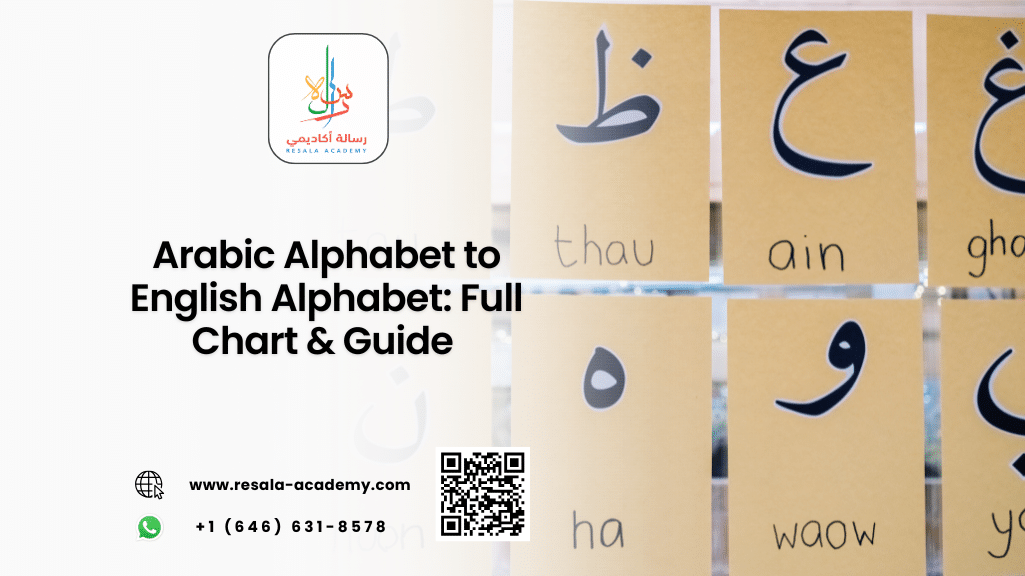
Arabic Alphabet to English Alphabet Chart: All 28 Letters
Here is the complete Arabic alphabet from alif to yā’ — the Arabic “A to Z” — with the closest English letters and a plain-English sound anchor for each.
How to read this chart
The English letters column shows how each letter is most often written in Latin script. The sounds like column gives your ear something familiar to hold onto.
A ★ marks sounds with no true English equivalent — the ones worth practicing with a native speaker rather than guessing from the page.
You’ll also meet hamza (ء), the “glottal stop” you already make in the middle of uh-oh. It’s usually counted alongside the 28 letters rather than among them.
The a to z Arabic alphabet in English
| # | Letter | Name | English letters | Sounds like |
|---|---|---|---|---|
| 1 | ا | alif | a / ā | “a” in father |
| 2 | ب | bā’ | b | “b” in book |
| 3 | ت | tā’ | t | “t” in table |
| 4 | ث | thā’ | th | “th” in think |
| 5 | ج | jīm | j | “j” in jam |
| 6 | ح | ḥā’ | ḥ | ★ breathy “h,” like fogging up glasses |
| 7 | خ | khā’ | kh | “ch” in Scottish loch |
| 8 | د | dāl | d | “d” in door |
| 9 | ذ | dhāl | dh | “th” in this |
| 10 | ر | rā’ | r | rolled “r,” as in Spanish |
| 11 | ز | zāy | z | “z” in zoo |
| 12 | س | sīn | s | “s” in sun |
| 13 | ش | shīn | sh | “sh” in ship |
| 14 | ص | ṣād | ṣ | ★ deep, heavy “s” |
| 15 | ض | ḍād | ḍ | ★ deep, heavy “d” |
| 16 | ط | ṭā’ | ṭ | ★ deep, heavy “t” |
| 17 | ظ | ẓā’ | ẓ | ★ deep, heavy “th”/”z” |
| 18 | ع | ʿayn | ʿ / 3 | ★ tight, throat-squeezed “a” |
| 19 | غ | ghayn | gh | ★ gargled “g,” like a French “r” |
| 20 | ف | fā’ | f | “f” in fish |
| 21 | ق | qāf | q | ★ “k” from deep in the throat |
| 22 | ك | kāf | k | “k” in kite |
| 23 | ل | lām | l | “l” in lamp |
| 24 | م | mīm | m | “m” in moon |
| 25 | ن | nūn | n | “n” in net |
| 26 | ه | hā’ | h | “h” in hat |
| 27 | و | wāw | w / ū | “w” in wet, or “oo” in moon |
| 28 | ي | yā’ | y / ī | “y” in yes, or “ee” in see |
Two details worth savoring. The letter ض (ḍād) is so distinctive that Arabic proudly calls itself لغة الضاد (lughat aḍ-ḍād) — “the language of the ḍād.” And ج (jīm) shifts by region: “j” in Modern Standard Arabic (Fusha), but a crisp “g” on the streets of Cairo — exactly the kind of nuance a native Egyptian tutor explains in seconds.
Arabic Alphabet Compared to English: Five Differences That Change How You Read
The chart is your map, but the terrain works differently. Five structural contrasts explain almost everything that surprises beginners.
Arabic flows right to left
Books open from what feels like the back; your eyes sweep the opposite way. Curiously, numerals inside Arabic text still run left to right, so your gaze does a small dance around dates and prices. Most learners report the direction flip feels natural within days, not weeks.
The script is always cursive — and letters shape-shift
Arabic letters join hands. Most take up to four forms depending on position, while six letters — ا، د، ذ، ر، ز، و — never connect to the letter after them, leaving small gaps mid-word. Here’s the letter ع (ʿayn) in all four positions:
| Position in word | Shape |
|---|---|
| Alone (isolated) | ع |
| Beginning | عـ |
| Middle | ـعـ |
| End | ـع |
Same letter, four outfits. Once you learn the pattern for one letter, the rest follow the same logic.
One case, no capitals
Arabic has no uppercase or lowercase, and no divide between “print” and “cursive” handwriting. What changes a letter’s appearance is its position, never its grammatical importance. Names, sentence openers, and titles all wear the same clothes.
Several sounds have no English twin
The throat letters ع، ح، غ، خ، ق and the four emphatic letters ص، ض، ط، ظ are new territory for English speakers. The stakes are real: قَلْب (qalb) means “heart,” while كَلْب (kalb) means “dog” — one letter pronounced deeper in the throat, and your love poem mentions the neighbor’s pet.
Charts can describe these sounds, but only live feedback corrects them, which is why practicing with native Egyptian Arabic tutors accelerates this stage more than any diagram.
Vowels play by different rules
Arabic writes its three short vowels as small marks (harakāt) above or below letters — fatḥa (a), kasra (i), ḍamma (u) — and everyday texts usually omit them entirely.
The three long vowels are full letters: ا، و، ي. Take كِتَاب (kitāb, “book”): the long ā is written as alif, while the short i is a tiny mark that beginner materials include and newspapers drop. Reading unvowelled Arabic is like seeing “bk” and knowing from context it says “book” — a skill that arrives sooner than you’d think.
Arabic to English Alphabet Translation: How Transliteration Really Works
Strictly speaking, alphabets are transliterated — matched sound-for-sound — rather than translated. Understanding this solves several beginner mysteries at once.
Why Muhammad, Mohammed, and Mohamed are all “correct”
Arabic writes the name exactly one way: مُحَمَّد. English, however, has no official method for representing sounds like the breathy ḥ, so multiple spellings coexist peacefully. Academic systems — such as the Library of Congress method — use precise marks like ḥ, ṣ, ʿ for scholarly accuracy, while everyday writing simplifies freely. Neither is wrong; they serve different jobs.
When numbers become letters: the Arabic chat alphabet
Arabic speakers texting on early Latin-only keyboards invented “Arabizi”, recruiting numerals whose shapes echo Arabic letters: 2 = ء, 3 = ع, 5 = خ, 7 = ح. So حَبِيبِي (ḥabībī, “my dear”) becomes 7abibi, and عَرَبِي (ʿarabī, “Arabic”) becomes 3arabi. Decoding your first Arabizi message is a genuine rite of passage.
Worked examples: Arabic words in English letters
| Arabic | In English letters | Meaning | What it teaches |
|---|---|---|---|
| سَلَام | salām | peace | The long “ā” is a real letter (alif); the greeting as-salāmu ʿalaykum grows from this root |
| شُكْرًا | shukran | thank you | One Arabic letter (ش) needs two English ones (sh) |
| عَيْن | ʿayn / 3ein | eye — also the name of letter ع | The symbol ʿ (or numeral 3) marks a sound English simply cannot spell |
| قَلْب / كَلْب | qalb / kalb | heart / dog | The q–k distinction carries meaning; transliteration guards it |
| الشَّمْس | al-shams → ash-shams | the sun | Written “al-,” pronounced “ash-” before “sun letters” — spelling and sound part ways |
Notice the pattern: transliteration is scaffolding. Brilliant for your first weeks, limiting after — because it hides exactly the distinctions that make Arabic Arabic.
From English to Arabic Alphabet: A Realistic Learning Path
Reading about the letters and reading them are different skills. Here’s how learners typically cross over.
A four-week starter plan
| Week | Focus | Milestone |
|---|---|---|
| 1 | Letter families (ب ت ث share one skeleton; so do ع غ and س ش) plus their sounds | Recognize all 28 isolated letters |
| 2 | The four positional forms and the six non-connectors | Spot letters inside whole words |
| 3 | Short vowels (harakāt) and simple vowelled words | Sound out سَلَام without the chart |
| 4 | Greetings and phrases; begin retiring transliteration | Read a short vowelled sentence aloud |
Pace is personal, of course. One-on-one lessons at Resala Academy bend this timeline around your life — slower where you need depth, faster where you’re flying — rather than forcing your life around a fixed syllabus.
Five habits that make letters stick
- Study in shape families. Learning ب ت ث together means one skeleton, three dots’ difference — a third of the effort.
- Say every sound aloud from day one. The script is phonetic; your ear and eye should grow together.
- Write by hand, right to left. Muscle memory anchors what flashcards alone cannot.
- Hunt for Arabic in the wild. Decode Arabizi messages, restaurant signs, and names you already know.
- Choose short daily sessions over weekend marathons. Fifteen focused minutes daily outperforms two exhausted hours on Sunday.
Mistakes worth avoiding
- Leaning on transliteration too long. Scaffolding helps you build; it becomes a problem only when you refuse to take it down.
- Treating “close” sounds as identical. ه vs. ح, ك vs. ق, س vs. ص — these pairs separate words with entirely different meanings.
- Memorizing only isolated forms. Real words hide letters in their connected shapes; practice recognition inside words early.
- Learning silently from charts alone. A native voice — and correction from one — is the difference between reading Arabic and approximating it.
Read more about: Varieties of Arabic: A Complete Guide to Dialects & Forms
From Your First Letter to Your First Conversation
If this guide has turned those flowing waves into individual, learnable letters, the natural next step is hearing them in a real human voice — and having your own pronunciation corrected kindly, in real time. That is precisely what Resala Academy was built to do for non-native speakers.
- Native Egyptian tutors whose mother tongue is Arabic guide every lesson, from alphabet to fluency.
- One-on-one sessions with flexible scheduling fit learners across the USA, UK, and every time zone between.
- A certificate of completion at each level documents your progress for academic or professional goals.
- Affordable pricing and five-star ratings from learners on Google and Trustpilot reflect a community, not just a classroom.
There’s no obligation and nothing to lose: book your free trial class today, meet your tutor, hear ع pronounced properly for the first time, and map out a plan that fits your goals.
Frequently Asked Questions
1. Can I learn Arabic using only the English alphabet?
You can start that way — transliteration is genuinely helpful in your first weeks. But Arabic spelling is far more regular than English spelling, and the script carries pronunciation information that Latin letters blur. Treat English letters as scaffolding to remove, not a floor to live on.
2. How long does it take to learn the Arabic alphabet?
With short, steady practice, many learners recognize all 28 letters within a few weeks, and connected reading follows soon after. Consistency matters far more than intensity — fifteen minutes daily beats occasional cramming every time.
3. Is the Arabic alphabet hard for English speakers?
Different more than difficult. Only a handful of sounds are truly new, and Arabic is written the way it sounds far more faithfully than English is. The shapes come quickly; the throat letters simply benefit from guided practice.
4. How are online alphabet classes conducted?
At Resala Academy, lessons are live, one-on-one video sessions with a native Arabic-speaking tutor, using shared on-screen materials and immediate pronunciation feedback. You set the schedule, learn at your own pace, and earn a certificate as you complete each level.
5. How do I stay motivated after the first excitement fades?
Tie letters to meaning early: read names you know, decode chat Arabic, label objects at home, and celebrate your first full word read unaided. A regular tutor who knows your goals adds the gentle accountability that self-study rarely provides.
Two Alphabets, One Bridge
Mapping the Arabic alphabet to English alphabet equivalents is the natural first move — and now you hold the whole map: 28 letters, a handful of gloriously new sounds, and differences in direction, connection, and vowels that turn out to be systems rather than obstacles. What looked like ocean waves is really a lattice, and lattices can be climbed.
Beyond the letters waits a language spoken by hundreds of millions and a heritage of poetry, scripture, and scholarship fourteen centuries deep. With patient native guidance, flexible structure, and a free first step, Resala Academy is ready whenever you are — and the sooner the letters become yours, the sooner the words will follow.