Table of Contents
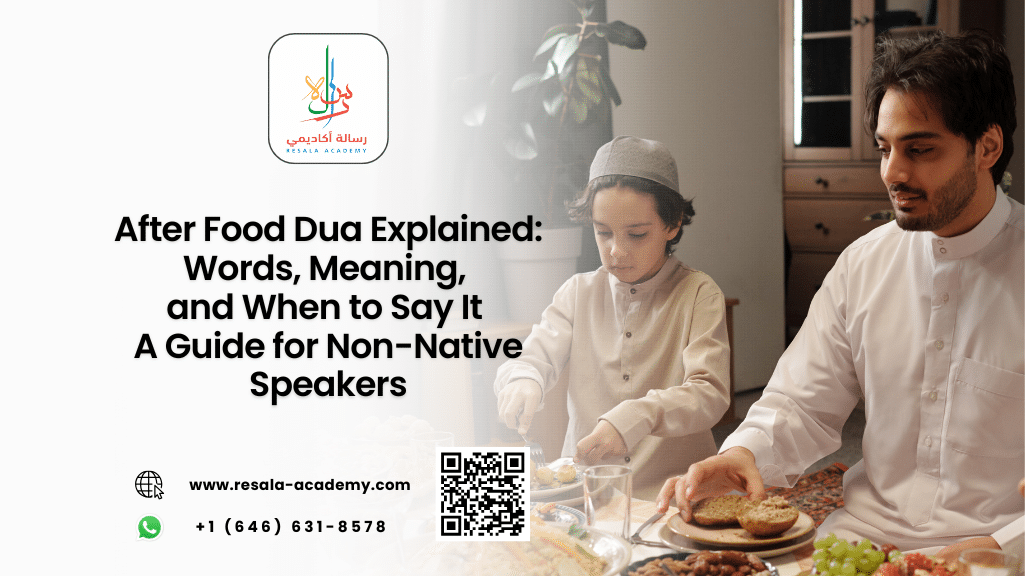
After Food Dua Explained: Words, Meaning, and When to Say It — A Guide for Non-Native Speakers
Eating is not only a physical necessity but also a spiritual act in Islam. The Prophet Muhammad ﷺ taught Muslims to be mindful of Allah before and after meals. One of the most beautiful expressions of this mindfulness is the after food dua — a short yet powerful supplication that reflects gratitude, humility, and remembrance of the Creator.
In this comprehensive guide, we will explore the dua after eating, its Arabic wording, meaning, significance, and the best time to recite it. This article is especially crafted for non-native speakers who wish to deepen their understanding of Islamic etiquette and language.
Whether you’re learning Arabic, studying the Quran, or simply trying to improve your Islamic practices, this guide — enriched with Quranic and Hadith references — will help you master the after food dua and understand its spiritual depth. Plus, we’ll introduce you to Resala Academy, a leading online platform for Arabic and Quran learning tailored specifically for non-native speakers.
What Is the After Food Dua?
The after food dua (دعاء بعد الطعام) is a supplication Muslims say after finishing a meal. It is an expression of gratitude to Allah for the sustenance provided. This practice is rooted in the Sunnah of the Prophet Muhammad ﷺ and is considered a virtuous act that brings blessings and rewards.
Arabic Text of the Dua
The most commonly recited dua after eating food is:
الْـحَمْـدُ للهِ الَّذِي أَطْعَمَنِي هَذَا، وَرَزَقَنِيهِ مِنْ غَيْرِ حَوْلٍ مِنِّي وَلَا قُوَّةٍ
Transliteration
Alhamdu lillāhil-ladhī aṭ‘amanī hādhā, wa razaqanīhi min ghayri ḥawlin minnī wa lā quwwah
English Translation
“All praise is for Allah who fed me this and provided it for me without any might or power from myself.”
This dua after food is a beautiful acknowledgment that all provisions come from Allah alone, and we are merely recipients of His mercy.
The Importance of Saying Dua After Eating
1. Gratitude to Allah
Gratitude (shukr) is a central theme in Islam. Allah says in the Quran:
وَإِذْ تَأَذَّنَ رَبُّكُمْ لَئِن شَكَرْتُمْ لَأَزِيدَنَّكُمْ ۖ وَلَئِن كَفَرْتُمْ إِنَّ عَذَابِى لَشَدِيدٌۭ
And ˹remember˺ when your Lord proclaimed, ‘If you are grateful, I will certainly give you more. But if you are ungrateful, surely My punishment is severe.’”
By saying the after food dua, a Muslim shows appreciation for Allah’s blessings, fulfilling a key spiritual obligation.
2. Following the Sunnah
The Prophet Muhammad ﷺ consistently expressed gratitude after meals. According to a Hadith in Sunan Abi Dawood:
“ مَنْ أَكَلَ طَعَامًا ثُمَّ قَالَ الْحَمْدُ لِلَّهِ الَّذِي أَطْعَمَنِي هَذَا الطَّعَامَ وَرَزَقَنِيهِ مِنْ غَيْرِ حَوْلٍ مِنِّي وَلاَ قُوَّةٍ غُفِرَ لَهُ مَا تَقَدَّمَ مِنْ ذَنْبِهِ وَمَا تَأَخَّرَ وَمَنْ لَبِسَ ثَوْبًا فَقَالَ الْحَمْدُ لِلَّهِ الَّذِي كَسَانِي هَذَا الثَّوْبَ وَرَزَقَنِيهِ مِنْ غَيْرِ حَوْلٍ مِنِّي وَلاَ قُوَّةٍ غُفِرَ لَهُ مَا تَقَدَّمَ مِنْ ذَنْبِهِ وَمَا تَأَخَّرَ ” .
“If anyone eats food and then says: “Praise be to Allah Who has fed me with this food and provided me with it through no might and power on my part,” he will be forgiven his former and later sins. If anyone puts on a garment and says: “Praise be to Allah Who has clothed me with this and provided me with it through no might and power on my part,” he will be forgiven his former and later sins.”
— Sunan Abi Dawood 4023
This Hadith highlights the immense reward of reciting the dua after eating food.
3. Cultivating Mindfulness
Reciting the after eating food dua fosters a mindful connection with Allah. It transforms a mundane act into a moment of spiritual reflection.
Read more about: The Moon in Arabic: Symbolism, Language, and Spiritual Significance for Non-Native Learners
When to Say the After Food Dua?
The after food dua should be recited immediately after finishing a meal. It can be said silently or aloud, individually or collectively. The key is sincerity and attentiveness.
Tips for Non-Native Speakers:
- Practice the Arabic text slowly and clearly.
- Use transliteration until you’re comfortable with the Arabic.
- Understand the meaning to enhance your connection with the words.
Variations of the After Food Dua
While the above dua is the most common, there are other authentic versions:
Dua #1
الْـحَمْـدُ للهِ الَّذِي أَطْعَمَنَا وَسَقَانَا وَجَعَلَنَا مُسْلِمِينَ
Transliteration: Alhamdu lillāhil-ladhī aṭ‘amanā wa saqānā wa ja‘alanā Muslimīn
Translation: “All praise is for Allah who fed us, gave us drink, and made us Muslims.”
Dua #2
اللَّهُمَّ بَارِكْ لَنَا فِيهِ وَأَطْعِمْنَا خَيْرًا مِنْهُ
Transliteration: Allāhumma bārik lanā fīhi wa aṭ‘imnā khayran minhu
Translation: “O Allah, bless it for us and feed us better than it.”
These variations can be learned and used interchangeably. Learning them is an excellent way to expand your Arabic vocabulary and deepen your spiritual practice.
Deepening Your Understanding of the After Food Dua Through Linguistic Analysis
For students of Arabic and Islamic studies, exploring the after food dua through a linguistic lens offers profound insights into Quranic language and prophetic eloquence. Each word in the dua after eating carries layers of meaning that reflect the richness of the Arabic language and the depth of Islamic theology.
- “Alhamdu lillah” (الحمد لله) — This phrase is a foundational expression of gratitude in Islam. The word “ḥamd” implies not just thanks, but praise with love and reverence, distinguishing it from mere acknowledgment.
- “Razaqanīhi” (رَزَقَنِيهِ) — Derived from the root “ر-ز-ق”, this verb emphasizes that provision is a divine act, not merely a result of human effort. It teaches learners the theological concept of rizq (sustenance) in Islam.
- “Min ghayri ḥawlin minnī wa lā quwwah” (مِنْ غَيْرِ حَوْلٍ مِنِّي وَلَا قُوَّةٍ) — A powerful reminder of human dependence on Allah. The terms “ḥawl” (ability) and “quwwah” (strength) are often found in Quranic verses and other duas, making this phrase a key vocabulary point for Arabic learners.
By dissecting the dua after food, students not only memorize a prophetic supplication but also gain a deeper appreciation for Arabic morphology, syntax, and spiritual semantics — all of which are taught in depth at Resala Academy.
Integrating the After Food Dua into Daily Islamic Practice
Beyond memorization, applying the after food dua in daily life reinforces both spiritual mindfulness and language retention. For non-native speakers, consistent usage of the dua after eating food turns every meal into an opportunity for worship and linguistic immersion.
- Create a daily ritual — Make it a habit to recite the dua after eating food after every meal, whether alone or with family. Repetition aids memorization and builds fluency in Arabic phrases.
- Use digital reminders — Set up notifications or use Islamic apps that prompt you to say the after food dua, helping you stay consistent and build a spiritual routine.
- Teach it in group settings — Practice the dua after food with children, friends, or study groups to reinforce learning and encourage communal remembrance of Allah.
- Listen to native recitations — Hearing the dua after eating recited by native speakers improves pronunciation and intonation, which is especially beneficial for learners focused on tajweed and Arabic phonetics.
At Resala Academy, students are guided not only in memorizing essential duas but also in integrating them into daily life — making their Islamic journey both practical and spiritually enriching.
Why Non-Native Speakers Should Learn the After Food Dua
For non-native speakers, mastering the dua after eating is more than just memorization. It’s a gateway to understanding Arabic, the Quran, and Islamic etiquette.
Benefits Include:
📘 Improved Arabic pronunciation
🕌 Deeper connection with Islamic traditions
🧠 Enhanced memory and cognitive skills
📿 Increased mindfulness in daily life
How Resala Academy Helps You Learn Duas and More
Resala Academy is a premier online institution offering structured, engaging, and authentic courses in Arabic, Quran, and Islamic studies for non-native speakers. Their curriculum is designed by scholars and educators who understand the unique challenges faced by learners from diverse backgrounds.
What Makes Resala Academy Stand Out?
✅ Native Arabic-speaking teachers
✅ Interactive, live online classes
✅ Flexible schedules for global learners
✅ Courses for all levels — from beginner to advanced
✅ Special focus on Quranic Arabic and Islamic etiquette
Whether you’re learning the after food dua, memorizing Quran, or mastering Arabic grammar, Resala Academy provides a supportive and enriching environment.
Nourish Your Soul with Every Meal — Enroll at Resala Academy Today!
Imagine transforming every bite you take into an act of worship. With Resala Academy, you don’t just learn how to say the dua after food — you understand it, feel it, and live it. Their expert instructors guide you through the Arabic language, Quranic verses, and prophetic traditions with clarity and compassion.
- Don’t wait to deepen your Islamic knowledge.
- Don’t settle for surface-level understanding.
- Join thousands of students worldwide who are learning to live Islam — one word at a time.
👉 Click here to enroll now and start your journey with Resala Academy!
Frequently Asked Questions (FAQ)
1. What is the correct dua after eating food?
The most commonly recited after food dua is:
الْـحَمْـدُ للهِ الَّذِي أَطْعَمَنِي هَذَا، وَرَزَقَنِيهِ مِنْ غَيْرِ حَوْلٍ مِنِّي وَلَا قُوَّةٍ
2. Can I say the dua in English if I don’t know Arabic?
Yes, you can say the dua after food in English while learning the Arabic version. However, it is highly recommended to learn the Arabic text for spiritual and linguistic benefits. Resala Academy offers courses that help you do just that.
3. Is there a specific time limit for saying the after food dua?
The after eating food dua should ideally be said immediately after finishing the meal. However, if you forget, you can say it as soon as you remember.
4. Are there different duas for different types of food?
No, the same dua after food can be recited regardless of the type of food. However, there are other specific duas for special occasions, such as when invited to someone’s house or during feasts. These are also taught at Resala Academy.
5. How can I teach my children the after food dua?
Start with repetition and visual aids. Use flashcards, posters, or apps. Enroll them in child-friendly Islamic courses like those offered by Resala Academy, where they learn through stories, songs, and interactive lessons.
Conclusion
The after food dua is more than a ritual — it’s a reminder of our dependence on Allah, a moment of gratitude, and a Sunnah that brings immense reward. For non-native speakers, learning this dua opens the door to deeper Islamic understanding and Arabic fluency.
With the guidance of Resala Academy, you can not only memorize this beautiful supplication but also internalize its meaning and live by its message. Let your journey of faith and language begin today — one dua at a time.