Table of Contents
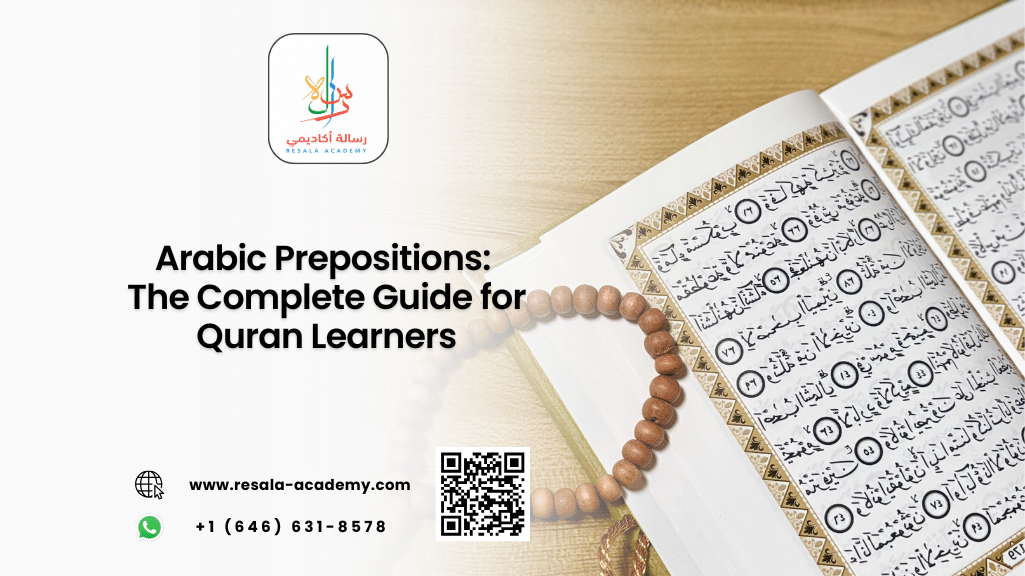
Arabic Prepositions: The Complete Guide for Quran Learners
Have you ever read a Quranic verse and noticed how a single small word completely changes the meaning of an entire sentence? Those small but powerful words are often Arabic prepositions — the essential connectors that shape meaning, context, and depth in every ayah you recite.
Understanding Arabic prepositions is one of the most important steps any non-native learner can take toward truly comprehending the Quran and the Arabic language. Known in Arabic grammar as حروف الجر (huruf al-jarr), these words may seem simple on the surface, but they carry immense grammatical weight and spiritual significance.
Whether you are just beginning your Arabic studies or working toward fluency, mastering prepositions in Arabic unlocks a deeper layer of understanding that pure translation simply cannot provide.
At Resala Academy, learners at every level gain access to native Egyptian tutors who specialize in breaking down Arabic grammar — including prepositions — in a way that is clear, practical, and connected to Quranic study. This guide will walk you through everything you need to know, from foundational definitions to the famous 17 prepositions in Arabic, complete with real examples and Quranic context.
What Are Prepositions in Arabic?
Prepositions in Arabic serve as the grammatical glue that connects nouns, pronouns, and phrases to the rest of a sentence. Before diving into the full list, it is important to understand what makes Arabic prepositions unique and why they deserve special attention from every learner.
Defining Huruf al-Jarr
In Arabic grammar, prepositions are called حروف الجر (huruf al-jarr), which literally translates to “particles of pulling” or “particles of attraction.” This name reflects their core grammatical function: every preposition in Arabic “pulls” the noun that follows it into the genitive case (حالة الجر — haalat al-jarr).
This means the noun’s ending changes, typically receiving a kasrah (the short vowel “i” sound) when it follows a preposition.
For example, the word بَيْت (bayt, meaning “house”) becomes بَيْتٍ (baytin) after a preposition, as in فِي بَيْتٍ (fī baytin — “in a house”). This genitive shift is a foundational rule that applies to every preposition in Arabic without exception.
Why Prepositions Matter for Quran Comprehension
For learners whose ultimate goal is to understand the Quran in its original language, prepositions are indispensable. A single preposition can alter the entire meaning of a Quranic verse. Consider the difference between عَلَيْهِم (ʿalayhim — “upon them”) and لَهُم (lahum — “for them”) — the choice of preposition in each case communicates a fundamentally different relationship between Allah and the people being described.
Without a solid grasp of how prepositions function, learners risk misunderstanding the subtleties that make the Quran’s language so precise and miraculous. This is why integrating grammar instruction with Quranic study — rather than treating them as separate subjects — proves far more effective for long-term comprehension.
The 17 Prepositions in Arabic: The Complete List
Arabic grammarians have traditionally identified 17 prepositions in Arabic. This is the canonical list taught across classical and modern Arabic curricula, and every serious student of the language should become familiar with all of them.
The Full List of Huruf al-Jarr
Below is the complete list of all Arabic prepositions along with their transliterations and primary meanings:
- مِنْ (min) — from, of
- إِلَى (ilā) — to, toward
- عَنْ (ʿan) — from, about, away from
- عَلَى (ʿalā) — on, upon, over
- فِي (fī) — in, within
- بِ (bi) — with, by, in
- لِ (li) — for, to, belonging to
- كَ (ka) — like, as, similar to
- وَ (wa) [oath] — by (used for swearing oaths)
- تَ (ta) [oath] — by (used exclusively in oaths involving Allah)
- مُذْ (mudh) — since (for past time)
- مُنْذُ (mundhu) — since, for (a duration of time)
- رُبَّ (rubba) — many a, perhaps
- حَتَّى (ḥattā) — until, up to
- خَلَا (khalā) — except, apart from
- عَدَا (ʿadā) — except, other than
- حَاشَا (ḥāshā) — far be it from, except
Understanding the Most Commonly Used Prepositions
While all 17 are important, the first eight prepositions on this list account for the overwhelming majority of usage in both everyday Arabic and the Quran. Learners who thoroughly master مِنْ, إِلَى, عَنْ, عَلَى, فِي, بِ, لِ, and كَ will find that their reading comprehension improves dramatically.
The remaining prepositions — particularly رُبَّ, خَلَا, عَدَا, and حَاشَا — appear more frequently in classical Arabic literature and poetry. However, for Quran learners, the oath prepositions وَ and تَ are especially significant, as Allah uses oaths frequently throughout the Quran to emphasize the gravity of what follows.
All Arabic Prepositions in Quranic Context
Seeing Arabic prepositions in real Quranic usage transforms abstract grammar rules into living, meaningful knowledge. The following examples demonstrate how prepositions shape the meaning of some of the most well-known verses.
Examples from the Quran
Example 1: بِسْمِ اللَّهِ الرَّحْمَنِ الرَّحِيمِ
(Bismillāhi ar-Raḥmāni ar-Raḥīm — “In the name of Allah, the Most Gracious, the Most Merciful”)
The preposition بِ (bi, meaning “in” or “with”) opens the most recited phrase in Islam. Notice how اسْم (ism, meaning “name”) takes the genitive case after بِ, becoming بِسْمِ. This single preposition establishes that every action a Muslim begins is undertaken through and in the name of Allah.
Example 2: وَالْفَجْرِ
(Wal-fajr — “By the dawn” — Surah Al-Fajr, 89:1)
Here, the preposition وَ (wa) functions as an oath particle. Allah swears by the dawn, and the noun الْفَجْر (al-fajr, “the dawn”) enters the genitive case. Understanding that وَ serves as a preposition of oath in this context — rather than simply meaning “and” — completely changes the reader’s appreciation of the verse’s power and rhetorical force.
Example 3: مِنَ السَّمَاءِ مَاءً
(Mina as-samāʾi māʾan — “From the sky, water” — referenced in multiple Quranic verses)
The preposition مِنْ (min, meaning “from”) indicates the origin or source of the water. The word السَّمَاء (as-samāʾ, “the sky”) takes the genitive case after مِنْ. This construction appears repeatedly throughout the Quran when describing Allah’s provision of rain as a sign of His mercy and power.
How Prepositions Shift Verb Meanings
One of the most fascinating aspects of Arabic prepositions is that the same verb can take on entirely different meanings depending on which preposition follows it. The verb رَغِبَ (raghiba) provides a striking illustration:
- رَغِبَ فِي (raghiba fī) — to desire something, to want it
- رَغِبَ عَنْ (raghiba ʿan) — to turn away from something, to have no desire for it
The preposition alone reverses the meaning entirely. This phenomenon is widespread in Arabic and is one of the reasons why studying prepositions is not optional for any learner who seeks to understand the Quran accurately and avoid misinterpretation.
Read more about: Definition of Jannah: Understanding Paradise in Islam
Preposition in Arabic Grammar: Essential Rules for Learners
Moving beyond vocabulary, there are specific grammatical rules governing how every preposition in Arabic interacts with the words around it. Understanding these rules prevents common errors and builds a stronger foundation for advanced study.
The Genitive Case and How It Works
As established earlier, every noun following a preposition must be in the genitive case (مجرور — majrūr). For most nouns, this means the final letter receives a kasrah (ـِ). For example, فِي الْمَسْجِدِ (fī al-masjidi — “in the mosque”) shows the dāl of مَسْجِد receiving a kasrah, and مِنَ الْكِتَابِ (mina al-kitābi — “from the book”) shows the bāʾ of كِتَاب receiving a kasrah.
For nouns that are diptotes (ممنوع من الصرف — mamnūʿ min al-ṣarf), the genitive marker is a fatḥah instead of a kasrah, unless the noun carries the definite article الـ (al-). These details matter significantly for accurate Quran recitation and Tajweed — the set of rules governing the proper pronunciation and recitation of the Quran.
Common Mistakes Non-Native Speakers Make
Non-native learners frequently encounter several specific pitfalls with Arabic prepositions:
- Translating prepositions literally from English. Arabic prepositions do not map one-to-one onto English equivalents. The preposition بِ alone can mean “with,” “by,” “in,” or “through” depending on context. Assigning a single English translation inevitably leads to confusion.
- Forgetting the genitive case. Beginners often neglect to change the noun ending after a preposition, which affects both written grammar and oral recitation accuracy.
- Confusing similar prepositions. The difference between مِنْ (from) and عَنْ (from/about) is subtle but significant. مِنْ indicates physical or temporal origin, while عَنْ conveys separation or being “about” a topic.
Working with a qualified tutor who corrects these mistakes in real time is one of the most effective ways to build lasting accuracy. At Resala Academy’s Arabic course, every lesson is conducted one-on-one with a native Arabic-speaking Egyptian tutor, giving learners the personalized feedback they need to avoid reinforcing errors early in their journey.
Practical Tips for Mastering Arabic Prepositions
Knowing the list and the rules is important, but true mastery of prepositions in Arabic comes from consistent, deliberate practice. The following strategies will help you internalize these essential particles and recognize them instinctively.
Daily Practice Strategies
- Read one page of the Quran daily and circle every preposition you find. This simple exercise trains your eye to recognize prepositions naturally and reveals how frequently they appear in Quranic text.
- Create flashcards pairing each preposition with a Quranic phrase. Contextual learning is far more effective than memorizing isolated words and definitions.
- Write short sentences using each of the 17 prepositions in Arabic. Active production builds recall much faster than passive recognition alone.
Learning Through Guided Instruction
Self-study can take you far, but having a knowledgeable teacher accelerates progress significantly. A tutor can explain why a particular preposition appears in a specific Quranic verse, clarify nuances that textbooks cannot fully capture, and correct pronunciation and grammatical errors on the spot.
This guided approach is central to how Resala Academy structures its Quran courses, blending grammar, vocabulary, and Quranic application into every session so learners build practical, interconnected knowledge.
Start Mastering Arabic Prepositions with Resala Academy
If this guide has revealed how much depth lies within Arabic prepositions, imagine what a structured course with a native Arabic-speaking tutor could unlock for your entire Arabic and Quran learning journey.
At Resala Academy, every lesson is tailored to your current level — whether you are a complete beginner encountering حروف الجر for the first time or an intermediate learner refining your understanding of Quranic grammar.
With flexible scheduling that accommodates time zones across the USA and the world, one-on-one sessions with certified Egyptian tutors, professional certification upon completion of each level, and affordable pricing designed for families, Resala Academy provides exactly the support and expertise non-native learners need to succeed.
Book your free trial class at Resala Academy today with absolutely no obligation. Experience firsthand how personalized instruction transforms the way you understand Arabic grammar, the Quran, and your connection to the language of revelation.
Frequently Asked Questions
Do I need to know any Arabic before learning Arabic prepositions?
No prior knowledge is required. Arabic prepositions are typically introduced early in beginner courses because they are fundamental to sentence structure. Resala Academy’s beginner programs start from the Arabic alphabet and build systematically toward grammar topics like prepositions.
How many prepositions are there in Arabic?
Classical Arabic grammar identifies 17 prepositions, known as حروف الجر (huruf al-jarr). While some appear far more frequently than others, all 17 are important for a comprehensive understanding of the language, especially for Quran study.
Can I learn Arabic prepositions through Quran study alone?
Quran study is an excellent way to encounter prepositions in meaningful context. However, combining Quran recitation with structured grammar instruction ensures you understand the rules behind what you are reading, not just the surface-level translation.
How long does it take to master all Arabic prepositions?
Most learners develop a strong working knowledge of the core prepositions within a few weeks of consistent study. Full mastery — including understanding how prepositions shift verb meanings and recognizing them instantly in Quranic text — develops over several months of practice and guided instruction.
Are online classes effective for learning Arabic grammar?
Yes, one-on-one online classes are highly effective for grammar instruction because the tutor provides immediate feedback and tailors explanations to your specific questions and mistakes. A personalized online session often outperforms large group settings for mastering detailed grammatical concepts like prepositions.
Conclusion
Arabic prepositions are small words that carry enormous weight — in grammar, in meaning, and in the profound language of the Quran. From the بِ that opens every Basmalah to the وَ that marks Allah’s solemn oaths, these particles are woven into the very fabric of the Arabic language.
Mastering all Arabic prepositions, especially the 17 prepositions in Arabic recognized by classical grammarians, gives learners the tools to move beyond surface-level translation and into genuine, heartfelt comprehension.
Whether you are beginning your Arabic journey or deepening your Quranic understanding, Resala Academy stands ready to guide you with expert native tutors, flexible scheduling, and a curriculum built specifically for non-Arabic speakers. Your path to understanding the language of the Quran starts with knowledge — and every great journey begins with a single step.