Table of Contents
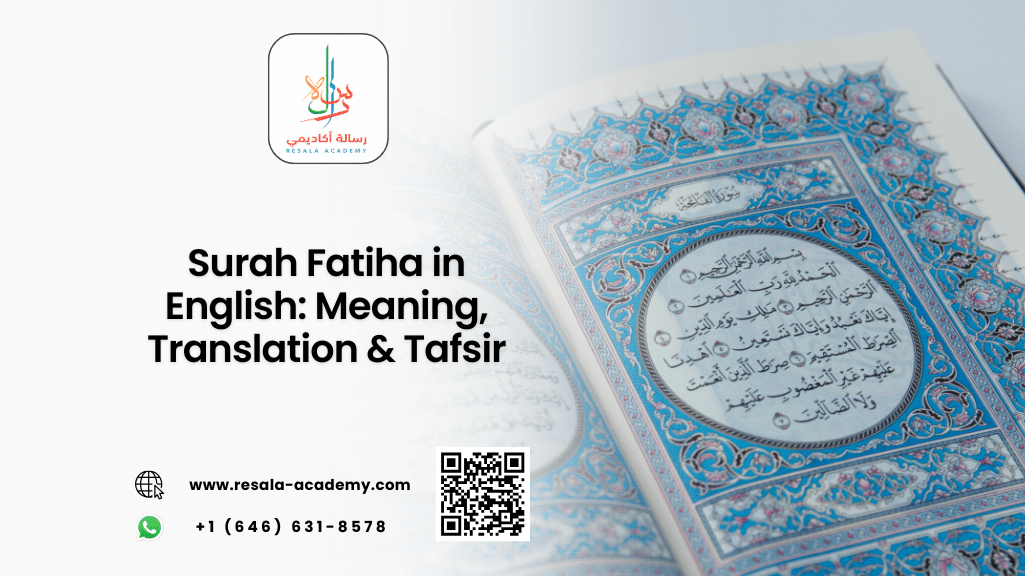
Surah Fatiha in English: Meaning, Translation & Tafsir
Every day, Muslims across the world recite Surah Al-Fatiha at least seventeen times during their daily prayers. Yet for millions of non-Arabic speakers, the profound words that open the Quran remain a mystery—recited beautifully, but not fully understood. If you have ever wondered what these sacred verses truly convey, reading Surah Fatiha in English is the first powerful step toward a deeper, more heartfelt connection with your prayer.
In this comprehensive guide, you’ll discover the complete translation, meaning, and tafsir (scholarly interpretation) of Surah Al-Fatiha. You’ll explore why classical scholars call it “The Mother of the Book,” learn the message behind each verse, and gain practical tools to reflect on its words during salah (the Islamic prayer).
At Resala Academy, we’ve guided thousands of non-Arabic speakers through this journey. Whether you’re a new Muslim, a parent teaching your children, or a lifelong believer seeking renewed understanding, you can explore our online Quran classes with native Arabic tutors to take this journey further.
What Is Surah Al-Fatiha in English? Understanding the Opening Chapter
Surah Al-Fatiha holds a unique place unlike any other chapter of the Quran—a status confirmed in both the Quran itself and the authentic Sunnah.
The Name and Meaning of Al-Fatiha
The Arabic word Al-Fatiha (الفاتحة) literally translates to “The Opening”. It opens the Quran and introduces every Muslim to their Creator. Scholars have honored it with several beautiful names, including:
- Umm al-Kitab — “The Mother of the Book”
- As-Sab’ al-Mathani — “The Seven Oft-Repeated Verses”
- Ash-Shifa — “The Cure”
- Al-Hamd — “The Praise”
Each title reveals a dimension of its depth. It is the foundation upon which the rest of the Quran is built.
Why Every Muslim Recites Surah Fatiha Daily
Surah Fatiha is an obligatory component of every unit (rak’ah) of the five daily prayers. A Muslim who completes all five daily prayers recites it at least 17 times per day—roughly 6,200 times per year.
This constant recitation is never meaningless repetition. Each reading is an opportunity to renew faith, seek divine guidance, and stand humbly before Allah. Understanding the translation in English of Surah Fatiha transforms each prayer from a recited ritual into a living conversation with the Divine.
Complete Translation in English of Surah Fatiha
Below is the full Arabic text of Surah Al-Fatiha with its authentic English translation by Sahih International, the most widely trusted English rendering.
Arabic Text with Sahih International English Translation
| # | Arabic | English Translation |
|---|---|---|
| 1 | بِسْمِ ٱللَّهِ ٱلرَّحْمَـٰنِ ٱلرَّحِيمِ | In the name of Allāh, the Entirely Merciful, the Especially Merciful. |
| 2 | ٱلْحَمْدُ لِلَّهِ رَبِّ ٱلْعَـٰلَمِينَ | [All] praise is [due] to Allāh, Lord of the worlds – |
| 3 | ٱلرَّحْمَـٰنِ ٱلرَّحِيمِ | The Entirely Merciful, the Especially Merciful, |
| 4 | مَـٰلِكِ يَوْمِ ٱلدِّينِ | Sovereign of the Day of Recompense. |
| 5 | إِيَّاكَ نَعْبُدُ وَإِيَّاكَ نَسْتَعِينُ | It is You we worship and You we ask for help. |
| 6 | ٱهْدِنَا ٱلصِّرَٰطَ ٱلْمُسْتَقِيمَ | Guide us to the straight path – |
| 7 | صِرَٰطَ ٱلَّذِينَ أَنْعَمْتَ عَلَيْهِمْ غَيْرِ ٱلْمَغْضُوبِ عَلَيْهِمْ وَلَا ٱلضَّآلِّينَ | The path of those upon whom You have bestowed favor, not of those who have earned [Your] anger or of those who are astray. |
Transliteration for Non-Arabic Speakers
For those still learning to read Arabic script, this transliteration offers a starting point:
- Bismillāhi r-raḥmāni r-raḥīm
- Al-ḥamdu lillāhi rabbi l-‘ālamīn
- Ar-raḥmāni r-raḥīm
- Māliki yawmi d-dīn
- Iyyāka na’budu wa iyyāka nasta’īn
- Ihdina ṣ-ṣirāṭa l-mustaqīm
- Ṣirāṭa lladhīna an’amta ‘alayhim ghayri l-maghḍūbi ‘alayhim wa la ḍ-ḍāllīn
Surah Fatiha in English Meaning: Verse-by-Verse Tafsir
Understanding surah fatiha in english meaning requires examining each verse individually, because every word was chosen by Allah with perfect wisdom.
Verse 1 — Bismillah: In the Name of Allah
This opening verse teaches us to begin every action in Allah’s name. The two attributes used—Ar-Rahman (the Most Gracious) and Ar-Rahim (the Most Merciful)—share the Arabic root r-ḥ-m meaning mercy. Ar-Rahman reflects Allah’s vast mercy extended to all creation, while Ar-Rahim refers to His specific mercy reserved for the believers.
Verses 2–4 — Praising Allah and His Attributes
Verses 2 through 4 establish who Allah is:
- “All praise is due to Allah, Lord of the worlds” — acknowledging Him as Creator and Sustainer of all realms.
- “The Most Gracious, the Most Merciful” — reminding us that His mercy precedes His justice.
- “Master of the Day of Judgment” — affirming His complete authority on the final day.
Together, these verses paint a comprehensive portrait of Allah: loving yet just, merciful yet sovereign.
Verse 5 — The Covenant of Worship
“You alone we worship, and You alone we ask for help.”
This is the theological heart of the surah—a declaration of pure Tawheed (Islamic monotheism). The Arabic grammar is deliberate: the word for “You” (إِيَّاكَ) is placed before the verb to emphasize exclusivity. We worship no one else, and we seek no ultimate help besides Him.
Verses 6–7 — The Prayer for Guidance
After acknowledging and praising Allah, the servant asks for what is most essential: guidance. The ṣirāṭ al-mustaqīm (Straight Path) is the way of prophets, the righteous, and the truthful. This supplication is repeated in every prayer because guidance is not a one-time achievement—it is an ongoing, lifelong need.
What Does Surah Fatiha Mean in English? Key Spiritual Themes
Beyond literal translation, this surah delivers life-shaping spiritual lessons.
Three Core Themes in Al-Fatiha
- The Pillar of Tawheed (Monotheism) — Every verse reinforces that Allah alone deserves worship, praise, and reliance.
- The Structure of True Prayer (Du’a) — The surah models perfect supplication: praise first, acknowledgment of Allah’s attributes, declaration of servitude, then requests.
- A Lifelong Request for Guidance — The surah reminds us that guidance is the deepest human need—more essential than wealth or health.
These themes elevate surah fatiha tarjuma in english from simple translation to a transformative blueprint for the believer’s daily life.
Quran and Hadith Evidence on Surah Fatiha
The unique status of Surah Al-Fatiha is confirmed by both the Quran and authentic Sunnah.
The Quran About Al-Fatiha
Allah Himself mentions this surah in the Quran:
وَلَقَدْ ءَاتَيْنَـٰكَ سَبْعًۭا مِّنَ ٱلْمَثَانِى وَٱلْقُرْءَانَ ٱلْعَظِيمَ
“And We have certainly given you, [O Muḥammad], seven of the often repeated [verses]1 and the great Qur’ān.”
— Quran 15:87
Scholars unanimously agree that the “seven oft-repeated verses” refer to Surah Al-Fatiha. This verse shows that even within the Quran itself, Allah honors this short chapter with a special mention.
Authentic Hadith on Al-Fatiha’s Virtue
The Prophet Muhammad ﷺ narrated this beautiful Hadith Qudsi:
. مَنْ صَلَّى صَلاَةً لَمْ يَقْرَأْ فِيهَا بِفَاتِحَةِ الْكِتَابِ فَهْىَ خِدَاجٌ. يَقُولُهَا ثَلاَثًا بِمِثْلِ حَدِيثِهِمْ .
“He who said his prayer, but did not recite the opening chapter of al-Kitab, his prayer is incomplete. He repeated it thrice.‘”
— Sahih Muslim 395
This profound hadith teaches that reciting Al-Fatiha is an actual dialogue with Allah. When the servant says “All praise is due to Allah, Lord of the worlds,” Allah responds, “My servant has praised Me.” When the servant asks for guidance, Allah answers the plea. Every prayer becomes a sacred conversation.
Surah Fatiha Tarjuma in English: Key Arabic Terms Explained
These Arabic words carry layers of meaning often lost in direct translation—a common challenge our students at Resala Academy learn to overcome through our Quran classes online.
Four Essential Words from Al-Fatiha
1. الحَمْدُ (Al-Ḥamd) — “All Praise”
Ḥamd combines two ideas: praise and gratitude given willingly and lovingly. Unlike madḥ (a mere compliment), ḥamd is praise that flows from recognition and love. No single English word fully captures this richness.
2. رَبّ (Rabb) — “Lord”
Rabb means far more than “Lord” in English. It carries the combined meanings of Creator, Sustainer, Nurturer, Owner, and Educator. Allah is the One who gradually brings each creation to its perfection.
3. العَالَمِينَ (Al-‘Ālamīn) — “The Worlds”
This plural term includes every realm of existence: humans, jinn, angels, animals, plants, galaxies, and realms beyond our knowledge. Allah is Lord of all of them.
4. الصِّرَاط (Aṣ-Ṣirāṭ) — “The Path”
Aṣ-Ṣirāṭ refers to a straight, paved, wide road leading directly to its destination. The path to Allah is clear and unbent; we simply need the guidance to stay on it.
Read more about: The Meaning of Namaz in Islam: A Spiritual Journey
Begin Your Quran Journey with Resala Academy
Understanding Surah Al-Fatiha in English is the first step toward a lifetime of meaningful connection with the Quran. But translation alone cannot replace the beauty of learning the Arabic language, perfecting your Tajweed (the rules of Quranic pronunciation), and exploring deeper meanings under the guidance of a qualified teacher.
At Resala Academy, non-native learners from the USA, UK, Canada, and beyond experience the Quran through:
- One-on-one sessions with native Egyptian tutors
- Flexible scheduling across all global time zones
- Customized lesson plans for kids, adults, and ladies
- Affordable pricing for families worldwide
- Professional certification upon each course completion
- 5-star ratings on both Google and Trustpilot
Whether you are a complete beginner or an advanced student, you’ll find a course tailored to your level. Book your free trial class today—no commitment, no pressure, just a chance to experience Quranic learning the way it was meant to be taught.
Frequently Asked Questions
1. Is it acceptable to recite Surah Fatiha in English during prayer?
According to the Sunni scholarly consensus, Surah Al-Fatiha must be recited in Arabic during salah. The English translation helps you understand the meaning, but the prayer itself requires the original Arabic text for validity.
2. How can a complete beginner start learning Surah Fatiha?
Begin by memorizing the Arabic pronunciation using transliteration, then gradually study the English meaning of each word. Enrolling in a structured program with a qualified tutor—such as those at Resala Academy—accelerates learning and ensures proper pronunciation from day one.
3. How long does it take to memorize Surah Fatiha properly?
Most students memorize Surah Al-Fatiha within one to two weeks with consistent daily practice of 10–15 minutes. Mastering correct Tajweed may take slightly longer, but a dedicated teacher can significantly accelerate your progress.
4. How can I stay motivated in learning Quran meanings?
Set small, consistent daily goals—like studying one verse per day—and pair with a study partner or tutor for accountability. Remind yourself that every word brings you closer to Allah and deepens the quality of your prayer.
5. How do I apply Surah Fatiha’s lessons in daily life?
Reflect on its themes during every prayer: remember Allah’s mercy when anxious, seek His guidance when making decisions, and praise Him when receiving blessings. Letting the surah shape your awareness transforms your entire day.
Conclusion
Surah Al-Fatiha is far more than a short chapter at the start of the Quran—it is a complete conversation between the servant and the Creator, a daily declaration of faith, and a lifelong prayer for guidance. Reading Surah Fatiha in English unlocks a depth of meaning that transforms every salah from routine into heartfelt worship.
Every journey of Quranic understanding begins with a single step—and that step becomes far easier when you have a qualified guide beside you. Resala Academy stands ready to help you move from recitation to true comprehension, one verse at a time, so that every “Alhamdulillāh” you say carries the full weight of knowledge, love, and gratitude it deserves.