Table of Contents
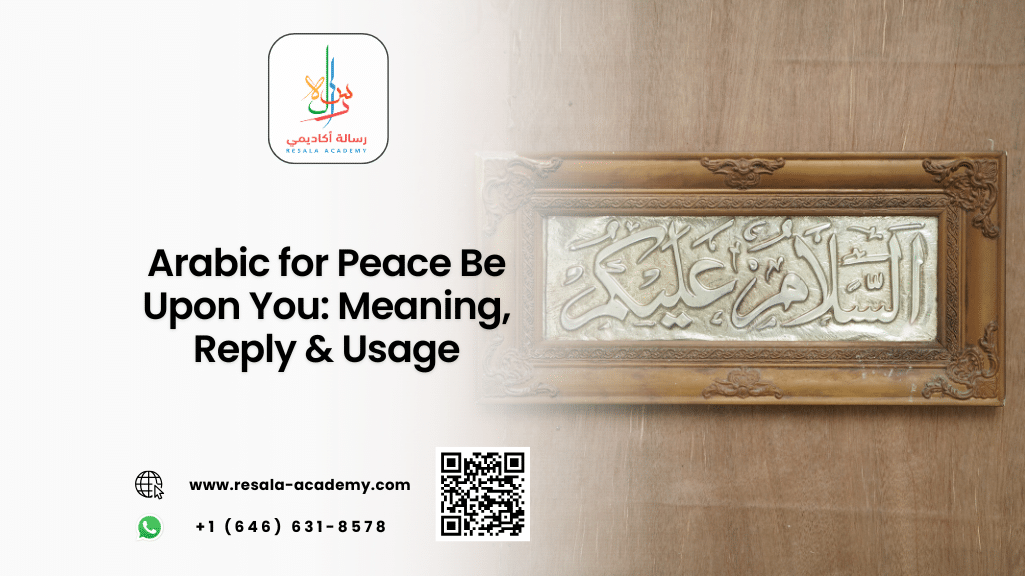
Arabic for Peace Be Upon You: Meaning, Reply & Usage
Imagine walking into a mosque for the first time, attending an Islamic gathering, or meeting a Muslim friend at work. Someone smiles warmly and says a beautiful phrase you’ve heard many times but never fully understood. That phrase is the most iconic greeting in the Muslim world—and learning the Arabic for peace be upon you is often the very first step non-native speakers take on their journey into the language of the Quran.
The greeting As-salamu alaykum (السَّلَامُ عَلَيْكُمْ) is more than a casual “hello.” It’s a heartfelt prayer, a Sunnah of Prophet Muhammad ﷺ, and a spiritual bridge connecting over 1.8 billion Muslims worldwide. Whether you’re a new Muslim, a curious learner, or someone deepening your Islamic knowledge, mastering this phrase correctly matters.
In this guide, you’ll learn the exact meaning of the greeting, its complete forms, how to pronounce it like a native speaker, when to use it, and how to respond properly. If you’d like structured guidance from certified Egyptian tutors, you can browse all Quran and Arabic courses at Resala Academy and begin learning at your own pace.
Understanding the Arabic for Peace Be Upon You
Before memorizing the phrase, it helps to understand what each word carries in meaning and spirit.
What Does As-salamu Alaykum Literally Mean?
The phrase As-salamu alaykum translates directly as “Peace be upon you.” Yet this English translation only scratches the surface of its depth.
The word salam (سلام) shares its root with one of Allah’s beautiful names, As-Salam (The Source of Peace). So when Muslims greet one another with this phrase, they are essentially invoking the peace of Allah Himself upon the other person. It is simultaneously a greeting, a supplication (du’a), and a declaration of goodwill.
Breaking Down the Arabic Words
Understanding each component helps non-native learners appreciate the greeting’s richness:
| Arabic Word | Transliteration | Meaning |
|---|---|---|
| السَّلَامُ | As-salamu | The peace |
| عَلَيْ | ‘Ala | Upon |
| كُمْ | kum | You (plural) |
| وَرَحْمَةُ اللهِ | Wa rahmatullah | And Allah’s mercy |
| وَبَرَكَاتُهُ | Wa barakatuh | And His blessings |
Notice that kum (كُمْ) is the plural “you” in Arabic. Even when greeting a single person, Muslims use the plural form—because every person is accompanied by their two recording angels (Kiraman Katibin), who are also included in the blessing.
Why This Greeting Matters in Islam
As-salamu alaykum is not optional cultural courtesy—it is a Sunnah (practice of the Prophet ﷺ) that strengthens bonds between believers. Spreading peace is considered one of the most beloved acts in Islam and a direct means of earning divine reward. Learning it correctly is the first meaningful Arabic phrase most converts and beginners master.
The Whole Phrase for Peace Be Upon You in Arabic
The whole phrase for peace be upon you in Arabic actually comes in three progressive levels, each earning more reward than the last.
Short Version: As-salamu Alaykum
The basic form is:
السَّلَامُ عَلَيْكُمْ
As-salamu alaykum
“Peace be upon you”
This is the minimum acceptable greeting and is suitable for brief encounters, text messages, or casual interactions with fellow Muslims.
Medium Version: Adding Rahmah (Mercy)
The second level expands the supplication:
السَّلَامُ عَلَيْكُمْ وَرَحْمَةُ اللهِ
As-salamu alaykum wa rahmatullah
“Peace be upon you and the mercy of Allah”
Complete Version: With Barakah (Blessings)
The fullest and most rewarding form is:
السَّلَامُ عَلَيْكُمْ وَرَحْمَةُ اللهِ وَبَرَكَاتُهُ
As-salamu alaykum wa rahmatullahi wa barakatuh
“Peace be upon you, and the mercy of Allah, and His blessings”
Which Version Should You Use?
According to an authentic narration, the Prophet ﷺ taught that each additional phrase earns ten additional rewards. Here’s a quick guide:
- Short form — Suitable for quick, informal encounters.
- Medium form — Ideal for regular daily greetings.
- Complete form — Recommended for deeper spiritual reward and when entering gatherings, homes, or greeting elders and scholars.
How to Pronounce the Arabic Greeting Correctly
Pronunciation matters in Arabic because a small shift in a sound can change a word’s meaning entirely. Learning from native speakers is essential, which is why many students choose to meet the native Egyptian Quran tutors at Resala Academy who specialize in teaching non-Arabic speakers.
Phonetic Breakdown for Non-Native Speakers
Here’s how to pronounce each part slowly:
- As — Pronounced like “us” in English but with a softer “s.”
- sa-la-mu — Three syllables: “sa” (like “sah”), “la” (like “lah”), “mu” (like “moo” but shorter).
- a-lay-kum — “a” (like “ah”), “lay” (rhymes with “lie”), “kum” (like “koom”).
Say it slowly at first: As-sa-la-mu-a-lay-kum. Gradually speed up as it becomes natural.
Common Pronunciation Mistakes to Avoid
Non-native learners frequently make these small but noticeable errors:
- Hardening the soft “s” — The Arabic letter س is a gentle, hissing sound, not sharp.
- Mispronouncing the ‘ayn (ع) — The “a” in alaykum comes from deep in the throat, not from the front of the mouth.
- Stressing the wrong syllable — The emphasis falls on la in salam and lay in alaykum.
- Dropping the shadda (doubling) — The “s” in As-salam is doubled (As-s), giving the word its characteristic rhythm.
Tips for Perfecting the Greeting
Listening is the fastest path to natural pronunciation. Watch Arabic-speaking imams deliver greetings, repeat after native speakers, and record yourself. With structured feedback from a qualified tutor, most beginners reach confident pronunciation within a few weeks.
Read more about: Surah Al-Falaq: Meaning, Translation & Recitation Guide
Proper Etiquette and Islamic Guidelines
Knowing the phrase is only half the lesson—using it correctly reflects true Islamic understanding.
Who Greets First?
Islamic etiquette gives specific guidance on who should initiate salam:
- The one riding greets the one walking.
- The one walking greets the one sitting.
- The smaller group greets the larger group.
- The younger person greets the older person.
However, the person who initiates the greeting earns the greater reward, so racing to greet first is encouraged.
Responding to the Greeting
Responding is an obligation (wajib) upon every Muslim who hears the greeting. The standard reply mirrors and often elevates the original:
وَعَلَيْكُمُ السَّلَامُ وَرَحْمَةُ اللهِ وَبَرَكَاتُهُ
Wa alaykum as-salam wa rahmatullahi wa barakatuh
“And upon you be peace, and Allah’s mercy, and His blessings”
A beautiful principle from the Quran is that Muslims should respond with a greeting equal to or better than the one offered.
When and Where to Use It
As-salamu alaykum can be used:
- When meeting any Muslim (in person, by phone, or in writing)
- When entering a home or room where people are present
- When joining or leaving a gathering
- At the beginning and end of speeches, letters, and emails
It is not typically used when entering an empty place, passing by strangers silently, or addressing non-Muslim audiences in formal settings—though kind secular greetings remain appropriate in those contexts.
Quran and Sunnah Evidence for the Islamic Greeting
The importance of salam is firmly established in both the Quran and authentic Prophetic traditions.
Quranic Foundation
Allah commands believers to return greetings with sincerity and generosity:
وَإِذَا حُيِّيتُم بِتَحِيَّةٍۢ فَحَيُّوا۟ بِأَحْسَنَ مِنْهَآ أَوْ رُدُّوهَآ ۗ إِنَّ ٱللَّهَ كَانَ عَلَىٰ كُلِّ شَىْءٍ حَسِيبًا
“And when you are greeted with a greeting, greet [in return] with one better than it or [at least] return it [in a like manner]. Indeed Allāh is ever, over all things, an Accountant.”
— Surah An-Nisa 4:86
This verse teaches that responding to salam is a divinely mandated act of kindness. If someone offers the short greeting, you may respond with the longer version—thus “greeting back with something better.”
Prophetic Tradition
The Prophet Muhammad ﷺ placed tremendous emphasis on spreading peace. In an authentic narration, a man asked the Messenger of Allah ﷺ which aspects of Islam were best, and he replied:
عَنْ عَبْدِ اللَّهِ بْنِ عَمْرٍو ـ رضى الله عنهما ـ أَنَّ رَجُلاً، سَأَلَ النَّبِيَّ صلى الله عليه وسلم أَىُّ الإِسْلاَمِ خَيْرٌ قَالَ ” تُطْعِمُ الطَّعَامَ، وَتَقْرَأُ السَّلاَمَ عَلَى مَنْ عَرَفْتَ وَمَنْ لَمْ تَعْرِفْ ”.
Narrated ‘Abdullah bin ‘Amr: A man asked the Prophet (ﷺ) , “What sort of deeds or (what qualities of) Islam are good?” The Prophet (ﷺ) replied, ‘To feed (the poor) and greet those whom you know and those whom you do not Know.
This hadith elevates salam to one of the core virtues of Islam, demonstrating that greeting peace upon strangers and friends alike is among the best deeds a Muslim can perform.
Specialized Examples for Non-Native Learners
Here are common practical phrases built around the greeting:
| Arabic | Transliteration | English Meaning |
|---|---|---|
| السَّلَامُ عَلَيْكُمْ | As-salamu alaykum | Peace be upon you |
| وَعَلَيْكُمُ السَّلَامُ | Wa alaykum as-salam | And upon you peace |
| السَّلَامُ عَلَيْكُمْ وَرَحْمَةُ اللهِ وَبَرَكَاتُهُ | As-salamu alaykum wa rahmatullahi wa barakatuh | Peace, mercy, and blessings of Allah be upon you |
| سَلَامٌ عَلَيْكُمْ | Salamun alaykum | Peace upon you (Quranic form) |
Notice the last form—Salamun alaykum—appears in the Quran itself (see Surah Al-An’am 6:54) as the very greeting Allah instructs His Prophet ﷺ to give believers. Learning this variation deepens both language skills and connection to the Quran, which is a core outcome of the Arabic Fusha curriculum taught at Resala Academy.
Begin Your Arabic and Quran Journey with Resala Academy
Learning the Arabic for peace be upon you is the perfect gateway to a deeper understanding of the Quran and the language of Islam. But mastering this greeting is only the beginning—there is an entire world of meaning waiting for you.
At Resala Academy, non-native learners succeed because of a model built specifically for them:
- Native Egyptian tutors — Learn authentic pronunciation from teachers for whom Arabic is the mother tongue.
- One-on-one personalized lessons — Your tutor adjusts every session to your pace and goals.
- Flexible scheduling across all time zones — Perfect for students in the USA, UK, Canada, Europe, and beyond.
- Courses for every age and level — From kids to adults, beginners to advanced.
- Female tutors for ladies’ classes — A comfortable, respectful learning environment.
- Professional certification — Recognized documentation at every level you complete.
- 5-star ratings on Google and Trustpilot from students worldwide.
- Free trial class — No obligation, no risk, just an honest introduction.
Don’t let pronunciation worries or time-zone barriers hold you back any longer. Book your free trial class today and take your first confident step into the beautiful language of the Quran.
Frequently Asked Questions
1. Can non-Muslims say As-salamu alaykum?
Yes, anyone may use the greeting respectfully. However, salam carries deep Islamic meaning, so many prefer to respond with a similar respectful greeting. Muslims traditionally offer the full greeting to fellow Muslims, though kindness in speech is encouraged with everyone.
2. Is learning the greeting enough, or should I learn more Arabic?
The greeting is a wonderful start, but Arabic opens the door to understanding the Quran directly. Most students who learn As-salamu alaykum become curious about more vocabulary, grammar, and eventually Quranic Arabic. A structured beginner course accelerates this journey significantly.
3. How long does it take to pronounce the greeting like a native?
With daily practice and feedback from a native tutor, most beginners achieve clear, confident pronunciation within 2–4 weeks. The key is regular listening, repetition, and corrective feedback—something a qualified instructor provides in every session.
4. What if I forget the long version and only remember the short form?
That’s completely fine. The short form As-salamu alaykum fulfills the Sunnah and is always acceptable. As your memory and comfort grow, you can gradually add wa rahmatullahi wa barakatuh for greater reward.
5. How do online Arabic classes actually work for beginners?
Classes are conducted through live video sessions with a dedicated tutor. Lessons include speaking practice, reading exercises, writing Arabic letters, and pronunciation drills. Everything is adjusted to your level, and you receive personalized homework and feedback after each session.
Conclusion
Mastering the Arabic for peace be upon you is far more than memorizing a phrase—it’s your first meaningful connection to the rich, beautiful language of the Quran. As-salamu alaykum carries the weight of prayer, community, and centuries of Islamic tradition in a single sentence. Every time you offer it, you send peace, mercy, and blessings to another soul.
Don’t stop here. Let this greeting be the doorway to deeper learning. With patient guidance, authentic native teachers, and a structured path, Resala Academy helps learners from every corner of the world move from their first salam to reciting the Quran with understanding and confidence. Your journey of knowledge and spiritual growth begins with one small, peace-filled step.