Table of Contents
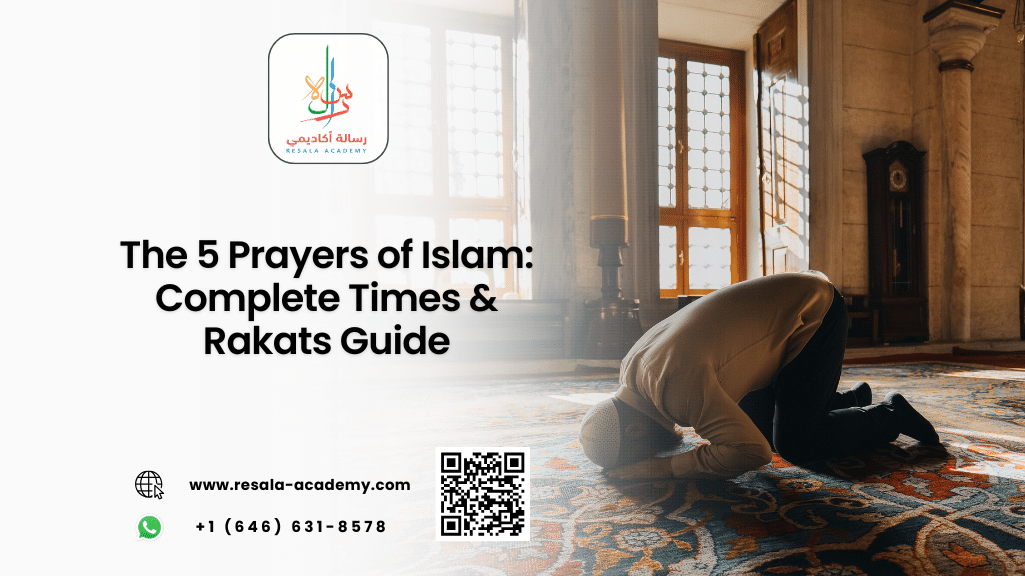
The 5 Prayers of Islam: Complete Times & Rakats Guide
For every Muslim, the daily rhythm of life is shaped by one extraordinary act of worship: the 5 prayers of Islam. Whether you are a new Muslim taking your first steps in faith, a parent guiding your children, or a lifelong believer seeking deeper meaning, learning how to perform Salah (the Arabic word for ritual prayer) correctly transforms your relationship with Allah. Yet for many non-Arabic speakers, questions about prayer times, Arabic recitation, and the number of rakats can feel confusing at first.
This comprehensive guide breaks down everything you need to know — from the exact times of each prayer to the spiritual significance behind every movement. You will discover the meaning of each Salah in English, learn essential Arabic phrases recited during prayer, and gain practical tools to make the five daily prayers a steady part of your life.
At Resala Academy, we have helped thousands of learners worldwide connect with the Quran and the Arabic language with confidence. If you would like personalized guidance from the very beginning, browse all our Quran and Arabic courses taught by qualified Egyptian tutors.
What Are the 5 Prayers of Islam? Understanding the Pillar of Salah
Salah is the second pillar of Islam and the most consistent act of worship in a Muslim’s daily life.
The Meaning of Salah in Islamic Tradition
The Arabic word Salah (صلاة) comes from a root meaning “connection” and “supplication.” In Islamic practice, Salah refers to the structured prayer performed five times a day, combining specific physical movements with recitation from the Quran. It is not merely a request to Allah — it is a moment of direct communication with the Creator.
The 5 daily prayers of Islam serve as anchors throughout the day, grounding believers in gratitude, humility, and remembrance. Each prayer takes only a few minutes but carries immense spiritual weight.
Why Allah Prescribed the 5 Daily Prayers of Islam
The five prayers were made obligatory during the miraculous Isra and Mi’raj (the Night Journey and Ascension), when the Prophet Muhammad (peace be upon him) was taken to the heavens. Initially, fifty prayers were prescribed, but through Allah’s mercy, the number was reduced to five, while still carrying the reward of fifty.
This timeless arrangement reflects divine wisdom: the prayers are spaced across the day to keep the heart connected to Allah from dawn until night.
The 5 Prayers of Islam Times and Rakats: A Complete Overview
Each prayer has its own designated window of time and a specific number of rakats (units of prayer).
Complete Schedule of the 5 Daily Prayers
The table below summarizes the 5 prayers of Islam, times, and rakats for easy reference:
| Prayer | Arabic Name | Time | Fard Rakats |
|---|---|---|---|
| Fajr | الفجر | From dawn until sunrise | 2 |
| Dhuhr | الظهر | After the sun passes its zenith | 4 |
| Asr | العصر | Mid-afternoon, when shadows lengthen | 4 |
| Maghrib | المغرب | Just after sunset | 3 |
| Isha | العشاء | After twilight disappears | 4 |
Total obligatory (Fard) rakats per day = 17
Understanding Rakats in Islamic Prayer
A rakat (ركعة) is one complete cycle of prayer that includes standing, bowing (ruku’), prostrating (sujood), and sitting. Each Salah has a fixed number of fard (obligatory) rakats, and most also include recommended Sunnah rakats for additional reward.
For non-Arabic speakers, mastering the structure of a single rakat is the foundation. Once you understand one cycle, performing two, three, or four becomes natural and consistent.
The 5 Prayers of Islam in English: Names and Spiritual Significance
Each of the five prayers has a unique character, time, and place in your day.
1. Fajr (Dawn Prayer) – 2 Rakats
Fajr is performed before sunrise, during the quiet hours of dawn. It is spiritually powerful and uniquely mentioned in the Quran as being witnessed by angels. Praying Fajr requires sincere devotion because it interrupts sleep, but it begins your day with light, gratitude, and connection to Allah.
2. Dhuhr (Noon Prayer) – 4 Rakats
Dhuhr is offered shortly after the sun passes its highest point in the sky. It serves as a midday pause from work, school, or daily activities to reorient the heart toward Allah, renewing your intentions in the middle of the day.
3. Asr (Afternoon Prayer) – 4 Rakats
Asr is the late-afternoon prayer and is often referred to as the “Middle Prayer” (Salat al-Wusta). The Prophet (peace be upon him) emphasized its great importance. It arrives during a busy time of day, making it a powerful test of consistency and priority.
4. Maghrib (Sunset Prayer) – 3 Rakats
Maghrib is performed immediately after the sun sets. With only three rakats, it is the only odd-numbered fard prayer and marks the transition from day to evening. Many families gather for Maghrib together, making it a beautiful time for spiritual bonding.
5. Isha (Night Prayer) – 4 Rakats
Isha is performed after the red twilight disappears from the sky. It is the final prayer of the day, closing your spiritual journey before sleep. Isha is often followed by the recommended Witr prayer, considered the seal of the night’s worship.
Read more about: Surah Bayyinah: Meaning, Translation & Timeless Lessons
Quran and Sunnah Evidence for the 5 Daily Prayers
Authentic Islamic teaching is grounded in the Quran and the Sunnah of the Prophet (peace be upon him).
The Quran on Prescribed Prayer Times
Allah commands believers to pray at specific times throughout the day:
إِنَّ ٱلصَّلَوٰةَ كَانَتْ عَلَى ٱلْمُؤْمِنِينَ كِتَـٰبًۭا مَّوْقُوتًۭا
“Indeed, prayer has been decreed upon the believers a decree of specified times.”
— Surah An-Nisa 4:103
This verse establishes that Salah is not flexible — it has fixed times that Muslims are commanded to observe.
A second verse reminds us that Allah designs worship to be a mercy rather than a burden:
يُرِيدُ ٱللَّهُ بِكُمُ ٱلْيُسْرَ وَلَا يُرِيدُ بِكُمُ ٱلْعُسْرَ
“Allah intends for you ease and does not intend for you hardship.”
— Surah Al-Baqarah 2:185
This principle of ease shapes every detail of the five daily prayers, making them accessible to people of every age and circumstance.
The Sunnah on the Lifelong Practice of Salah
The Prophet Muhammad (peace be upon him) spent his entire mission teaching and living the practice of Salah. As reported in Sahih al-Bukhari:
لَبِثَ النَّبِيُّ ﷺ بِمَكَّةَ عَشْرَ سِنِينَ يُنْزَلُ عَلَيْهِ الْقُرْآنُ وَبِالْمَدِينَةِ عَشْرَ سِنِينَ
“The Prophet (ﷺ) remained in Mecca for ten years, during which the Qur’an used to be revealed to him; and he stayed in Medina for ten years.”
— Sahih al-Bukhari 4978
Throughout these decades, the Prophet (peace be upon him) consistently modeled the five daily prayers, leaving his community with a clear and unbroken example to follow.
Essential Arabic Phrases in the 5 Prayers of Islam
For non-native learners, recognizing key Arabic phrases makes Salah more meaningful and easier to memorize.
Specialized Examples for Non-Arabic Speakers
Below are foundational phrases recited in every prayer, with pronunciation notes and meanings:
الله أكبر — Allahu Akbar
“Allah is the Greatest.” This phrase begins every prayer and is repeated at each transition. The “k” should be clearly pronounced — not as a heavy “kh.”سُبْحَانَ رَبِّيَ الْعَظِيمِ — Subhana Rabbiyal-Adheem
“Glory be to my Lord, the Most Great.” Recited three times during bowing (ruku’). The word Adheem describes Allah’s incomparable greatness.سُبْحَانَ رَبِّيَ الْأَعْلَى — Subhana Rabbiyal-A’la
“Glory be to my Lord, the Most High.” Recited three times during prostration (sujood). The word A’la emphasizes Allah’s elevation above all things.السَّلَامُ عَلَيْكُمْ وَرَحْمَةُ اللَّهِ — As-salamu alaykum wa rahmatullah
“Peace and the mercy of Allah be upon you.” Spoken at the end of prayer while turning the head right and then left.
Learning correct pronunciation requires expert guidance. Meet our native Egyptian Quran tutors at Resala Academy, who help students perfect Arabic articulation through one-on-one online sessions.
How to Find the 5 Prayers of Islam Times Today
Knowing the exact prayer times for your location is essential for consistent practice.
Tools to Calculate Accurate Prayer Times
Modern Muslims have many simple ways to determine the 5 prayers of Islam times today:
- Prayer time apps such as Muslim Pro, Athan, or IslamicFinder use GPS to calculate accurate times for your exact city.
- Local mosque schedules — most masjids publish monthly prayer timetables based on local astronomical calculations.
- Online Islamic resources offer reliable daily schedules for any global location.
- Adhan notifications on your phone ensure you never miss the call to prayer.
Prayer times shift each day slightly based on the sun’s position, so checking a reliable source daily is the best habit to build.
Begin Your Quran and Prayer Journey with Resala Academy
Learning the 5 prayers of Islam is a beautiful first step, but truly understanding Salah — its Arabic words, its meaning, and its proper recitation — requires expert guidance from someone who lives and breathes the language.
At Resala Academy, we specialize in teaching non-Arabic speakers worldwide. Our students benefit from:
- Native Egyptian tutors with deep expertise in Quran and Arabic instruction.
- One-on-one online sessions tailored to your personal pace and goals.
- Flexible scheduling that fits every time zone, from the USA and UK to anywhere in the world.
- Female tutors available for ladies who prefer a comfortable learning environment.
- Free trial classes with no obligation to commit.
- Affordable pricing designed for individuals and families.
- Professional certification is awarded upon completing each course level.
With 5-star ratings on both Google and Trustpilot, Resala Academy has earned the trust of thousands of learners across the globe. Whether you want to recite Salah confidently, memorize Surahs, or master Arabic Fusha, the right course is waiting for you. Book your free trial class today and take your first step toward meaningful, confident prayer.
Frequently Asked Questions
1. What are the 5 prayers of Islam in order?
The five daily prayers, in order, are Fajr (dawn), Dhuhr (noon), Asr (afternoon), Maghrib (sunset), and Isha (night). Together they total 17 fard rakats per day and form the backbone of a Muslim’s spiritual routine.
2. How can a complete beginner learn the 5 daily prayers of Islam?
Beginners should start with the structure of one rakat — learning the Arabic phrases and physical movements step by step. Explore Resala Academy’s beginner-friendly Quran courses for personalized guidance from native tutors who explain everything in clear English.
3. Are the 5 prayers of Islam times the same every day?
No. Prayer times shift each day slightly based on the sun’s movement and your geographic location. A reliable prayer time app or your local mosque schedule will give you accurate daily times wherever you live.
4. How do I memorize the Arabic recitations for Salah?
Consistency is key. Practice each phrase aloud every day, listen to accurate recitations, and learn under a qualified teacher who can correct your pronunciation. Most learners progress quickly with structured one-on-one sessions.
5. What if I miss one of the 5 daily prayers of Islam?
If you miss a prayer unintentionally, perform it as soon as you remember (this make-up prayer is called qada). The Prophet (peace be upon him) taught that prayers missed due to sleep or forgetfulness should be made up without delay.
Conclusion
The 5 prayers of Islam are far more than a daily ritual — they are a divine gift that anchors your day in remembrance, gratitude, and closeness to Allah. Understanding the times, rakats, and meanings of each prayer transforms Salah from a duty into a deeply personal source of peace and purpose.
For non-Arabic speakers, the journey of learning Salah and the Quran is best walked with a knowledgeable guide. Resala Academy is here to support you with native Egyptian tutors, flexible online classes, and a learning experience tailored to your goals. Begin today, and discover the lasting beauty of standing before Allah five times each day.