Table of Contents
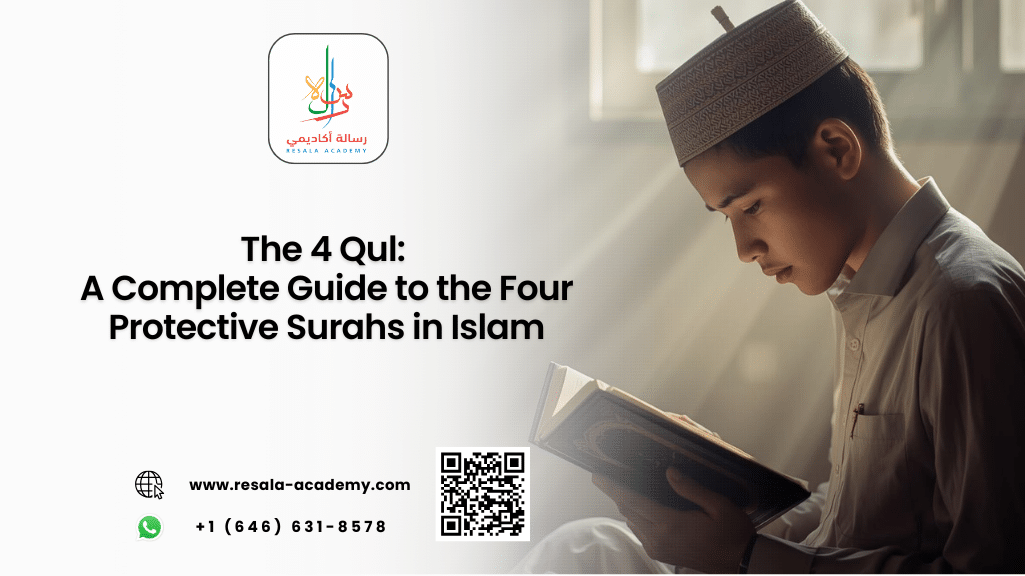
The 4 Qul: A Complete Guide to the Four Protective Surahs in Islam
The 4 Qul represent four of the most powerful and frequently recited surahs in the Quran, each beginning with the Arabic word “Qul,” meaning “Say.” These short yet profound chapters hold immense spiritual significance in the daily lives of Muslims worldwide, offering protection, affirming faith, and strengthening the connection between the believer and Allah.
For non-native Arabic speakers, understanding the 4 Quls can feel challenging at first. Many learners struggle to grasp not only the pronunciation but also the deep meanings embedded within these verses. However, with proper guidance and structured learning, anyone can develop a meaningful relationship with these surahs and recite them with confidence and understanding.
This comprehensive guide explores everything you need to know about the 4 Qul Surah collection, including their meanings, benefits, and practical applications. Whether you are new to Islamic learning or seeking to deepen your existing knowledge, this resource will provide valuable insights supported by authentic evidence from the Quran and Sunnah.
Understanding the 4 Qul in Islam
The 4 Qul surahs are among the most memorized chapters of the Quran, cherished by Muslims for their ease of recitation and profound spiritual benefits.
What Are the 4 Qul Surahs?
The 4 Quls consist of four short surahs located at the end of the Quran. Each surah addresses fundamental aspects of Islamic belief and offers specific spiritual protections.
The four surahs include:
- Surah Al-Kafirun (Chapter 109): A declaration of disassociation from disbelief and affirmation of pure monotheism
- Surah Al-Ikhlas (Chapter 112): A powerful statement on the Oneness and uniqueness of Allah
- Surah Al-Falaq (Chapter 113): Seeking refuge in Allah from external harms and evil
- Surah An-Nas (Chapter 114): Seeking protection from the whispers of Shaytan and internal spiritual dangers
These surahs are often recited together, forming a complete spiritual shield for the believer. Their brevity makes them accessible to learners at all levels, while their depth continues to inspire scholars and students alike.
Why Are They Called “Qul”?
Each of the 4 Qul Surah chapters begins with the command “Qul” (قُلْ), which is a direct instruction from Allah to the Prophet Muhammad (peace be upon him) to proclaim specific truths.
This linguistic structure creates an intimate dialogue between the Creator and His creation. When Muslims recite these verses, they are essentially following a divine command, speaking words that Allah Himself instructed His Messenger to declare.
The repetition of “Qul” across these four chapters emphasizes the importance of verbal affirmation in Islam. Words carry weight, and these declarations serve as both personal reminders and public testimonies of faith. Learners studying Arabic through institutions like Resala Academy often discover how understanding this single word transforms their appreciation of these surahs.
Read more about: The Last Two Ayats of Surah Baqarah: A Complete Guide to Their Meaning, Virtues, and Benefits
The 4 Qul in English: Complete Translation and Meaning
Understanding the 4 Qul in English helps non-native speakers connect with the message while they work on mastering the Arabic recitation.
Surah Al-Kafirun (The Disbelievers)
This surah establishes clear boundaries between monotheistic worship and polytheism, affirming that a Muslim’s worship belongs exclusively to Allah.
Arabic Text:
قُلْ يَا أَيُّهَا الْكَافِرُونَ لَا أَعْبُدُ مَا تَعْبُدُونَ وَلَا أَنتُمْ عَابِدُونَ مَا أَعْبُدُ وَلَا أَنَا عَابِدٌ مَّا عَبَدتُّمْ وَلَا أَنتُمْ عَابِدُونَ مَا أَعْبُدُ لَكُمْ دِينُكُمْ وَلِيَ دِينِ
English Translation:
“Say, O disbelievers, I do not worship what you worship. Nor are you worshippers of what I worship. Nor will I be a worshipper of what you worship. Nor will you be worshippers of what I worship. For you is your religion, and for me is my religion.”
Reference: Quran.com – Surah Al-Kafirun
This surah teaches Muslims to maintain their religious identity with dignity and clarity while respecting the principle that faith cannot be coerced.
Surah Al-Ikhlas (The Sincerity)
Often considered equal to one-third of the Quran in reward, this surah encapsulates the essence of Islamic monotheism.
Arabic Text:
قُلْ هُوَ اللَّهُ أَحَدٌ اللَّهُ الصَّمَدُ لَمْ يَلِدْ وَلَمْ يُولَدْ وَلَمْ يَكُن لَّهُ كُفُوًا أَحَدٌ
English Translation:
“Say, He is Allah, [who is] One. Allah, the Eternal Refuge. He neither begets nor is born. Nor is there to Him any equivalent.”
Reference: Quran.com – Surah Al-Ikhlas
This brief yet comprehensive surah negates all forms of polytheism and establishes Allah’s absolute uniqueness. Students at Resala Academy learn that understanding the Arabic terms in this surah, particularly “Ahad” (One) and “As-Samad” (The Eternal Refuge), unlocks profound theological concepts.
Surah Al-Falaq (The Daybreak)
This surah seeks protection from external harms and the evil that exists in creation.
Arabic Text:
قُلْ أَعُوذُ بِرَبِّ الْفَلَقِ مِن شَرِّ مَا خَلَقَ وَمِن شَرِّ غَاسِقٍ إِذَا وَقَبَ وَمِن شَرِّ النَّفَّاثَاتِ فِي الْعُقَدِ وَمِن شَرِّ حَاسِدٍ إِذَا حَسَدَ
English Translation:
“Say, I seek refuge in the Lord of daybreak. From the evil of that which He created. And from the evil of darkness when it settles. And from the evil of the blowers in knots. And from the evil of an envier when he envies.”
Reference: Quran.com – Surah Al-Falaq
Surah An-Nas (Mankind)
The final surah of the Quran seeks protection from spiritual dangers, particularly the whispers that lead hearts astray.
Arabic Text:
قُلْ أَعُوذُ بِرَبِّ النَّاسِ مَلِكِ النَّاسِ إِلَٰهِ النَّاسِ مِن شَرِّ الْوَسْوَاسِ الْخَنَّاسِ الَّذِي يُوَسْوِسُ فِي صُدُورِ النَّاسِ مِنَ الْجِنَّةِ وَالنَّاسِ
English Translation:
“Say, I seek refuge in the Lord of mankind. The Sovereign of mankind. The God of mankind. From the evil of the retreating whisperer. Who whispers [evil] into the breasts of mankind. From among the jinn and mankind.”
Reference: Quran.com – Surah An-Nas
The Virtues of 4 Qul and Ayatul Kursi
The combination of 4 Qul and Ayatul Kursi creates a comprehensive spiritual protection that the Prophet Muhammad (peace be upon him) recommended for daily recitation.
Authentic Hadith on Their Benefits
The Sunnah contains numerous narrations highlighting the importance of these verses. Understanding these narrations motivates consistent practice.
The Prophet (peace be upon him) said regarding Surah Al-Ikhlas, Al-Falaq, and An-Nas:
“Say, He is Allah, One,” and al-Mu’awwadhatan three times in the morning and evening; they will serve you for every purpose.”
” { قُلْ هُوَ اللَّهُ أَحَدٌ } وَالْمُعَوِّذَتَيْنِ حِينَ تُمْسِي وَحِينَ تُصْبِحُ ثَلاَثَ مَرَّاتٍ تَكْفِيكَ مِنْ كُلِّ شَىْءٍ ” .
Reference: Sunnah.com – Sunan Abi Dawud
Aisha (may Allah be pleased with her) reported that the Prophet (peace be upon him) would recite the Mu’awwidhatayn (Al-Falaq and An-Nas) and blow over his body before sleeping. This practice demonstrates the protective nature of these surahs.
The virtue of Ayatul Kursi
When combined with the 4 Qul, Ayatul Kursi (Quran 2:255) completes a powerful daily protection routine. The Prophet (peace be upon him) described it as the greatest verse in the Quran, and its recitation before sleep invokes angelic protection throughout the night.
Daily Practices and Recommended Times
Incorporating the 4 Quls into daily routines transforms ordinary moments into opportunities for spiritual connection.
Recommended times for recitation include:
- Morning and evening adhkar: Reciting each surah three times provides protection throughout the day and night
- Before sleeping: Following the Prophetic tradition of reciting and blowing over oneself
- After every obligatory prayer: Many scholars recommend reciting these surahs following the daily prayers
- During times of distress: Seeking refuge through these words brings comfort and divine protection
Learning the 4 Qul with Proper Tajweed
Correct pronunciation enhances both the spiritual experience and the reward of recitation.
Common Pronunciation Challenges
Non-native speakers often encounter specific difficulties when learning the 4 Qul Surah collection. Recognizing these challenges is the first step toward overcoming them.
Frequent areas of difficulty include:
- The letter Qaf (ق): This deep guttural sound in “Qul” requires proper throat positioning
- Distinguishing between similar letters: Such as the difference between ح and ه or between ع and أ
- Proper elongation (Madd): Knowing when to extend vowel sounds affects meaning and correctness
- Stopping and starting points: Understanding where to pause maintains the intended meaning
Resala Academy specializes in helping non-native speakers master these challenges through structured Tajweed courses. Their qualified instructors understand the specific difficulties faced by learners from different linguistic backgrounds.
Building a Strong Foundation
Effective Quran learning requires patience and systematic study. Random memorization without understanding leads to stagnation.
A structured approach includes:
- Learning the Arabic alphabet with correct pronunciation
- Understanding basic Tajweed rules before advancing
- Memorizing with meaning to enhance retention
- Regular revision to prevent forgetting
- Reciting to a qualified teacher for correction
Students who invest time in learning Arabic alongside Quran memorization experience deeper connection with the text. This holistic approach, which institutions like Resala Academy emphasize, transforms recitation from mere repetition into meaningful worship.
Begin Your Quranic Journey Today with Resala Academy
Your path to mastering the Quran and Arabic begins with the right guidance and support.
Why Non-Native Learners Succeed with Resala Academy
Resala Academy has established itself as a leading online academy for non-native speakers seeking authentic Islamic education. Their comprehensive programs address the unique needs of learners who did not grow up speaking Arabic.
What makes Resala Academy effective:
- Specialized curriculum: Courses designed specifically for non-native speakers, addressing common learning obstacles
- Qualified instructors: Teachers trained in both Arabic linguistics and Tajweed sciences
- Flexible scheduling: Online classes that accommodate learners in different time zones
- Progressive learning paths: From complete beginner to advanced levels in Arabic, Quran, and Islamic Studies
- Personalized attention: Small class sizes ensure individual feedback and correction
Whether you want to perfect your recitation of the 4 Quls, understand the Quran in its original Arabic, or pursue comprehensive Islamic Studies, Resala Academy provides the structured environment needed for success. Begin your journey today and experience the transformation that comes with understanding Allah’s words in their original language.
Frequently Asked Questions
1. How long does it take to memorize the 4 Qul?
Most learners can memorize the 4 Qul within one to two weeks of consistent daily practice. Since these surahs are short, dedicating fifteen to twenty minutes daily for recitation and review typically yields strong retention. The key is regular repetition rather than lengthy single sessions.
2. Do I need to understand Arabic to benefit from reciting the 4 Qul?
While recitation brings reward regardless of understanding, learning the meanings significantly enhances spiritual benefit and connection. Many scholars encourage studying translations alongside memorization. Over time, learning Arabic enables direct comprehension, which deepens the impact of each word during prayer and supplication.
3. What is the correct order for reciting the 4 Qul?
There is no strictly mandated order, but following the sequence in the Quran is common: Al-Kafirun, Al-Ikhlas, Al-Falaq, and An-Nas. Some narrations mention the Prophet (peace be upon him) reciting Al-Ikhlas followed by the two Mu’awwidhatayn (Al-Falaq and An-Nas). Both approaches are valid.
4. How can I stay consistent with daily recitation?
Consistency comes from linking recitation to existing habits. Attach your recitation to prayers you already perform or to morning and evening routines. Starting with the 4 Quls is manageable because of their brevity. Using apps with reminders, joining accountability groups, or enrolling in structured programs like those at Resala Academy helps maintain momentum.
5. Is online learning effective for Quran and Arabic studies?
Online learning has proven highly effective, especially when programs are designed with interactive elements and qualified instructors. Platforms like Resala Academy offer one-on-one sessions where teachers can correct pronunciation in real-time. The flexibility of online learning often allows for more consistent study than traditional classes, leading to better outcomes for dedicated students.
Conclusion
The 4 Qul surahs offer Muslims a powerful combination of spiritual protection, theological clarity, and daily connection with the Quran. From affirming pure monotheism in Surah Al-Ikhlas to seeking refuge from all forms of evil in the Mu’awwidhatayn, these chapters address fundamental aspects of faith that every Muslim needs.
Understanding these surahs in both Arabic and English transforms recitation from routine into meaningful worship. The journey toward mastering the 4 Qul and Ayatul Kursi becomes even more rewarding when learners invest in proper Arabic and Tajweed education.
Resala Academy stands ready to guide non-native speakers through this transformative journey, offering specialized instruction in Arabic language, Quran recitation, and Islamic Studies. With qualified teachers and proven methods, learners gain the skills and confidence needed to connect deeply with Allah’s words. Take the first step today, and let the 4 Qul become a source of daily protection and spiritual growth in your life.