Table of Contents
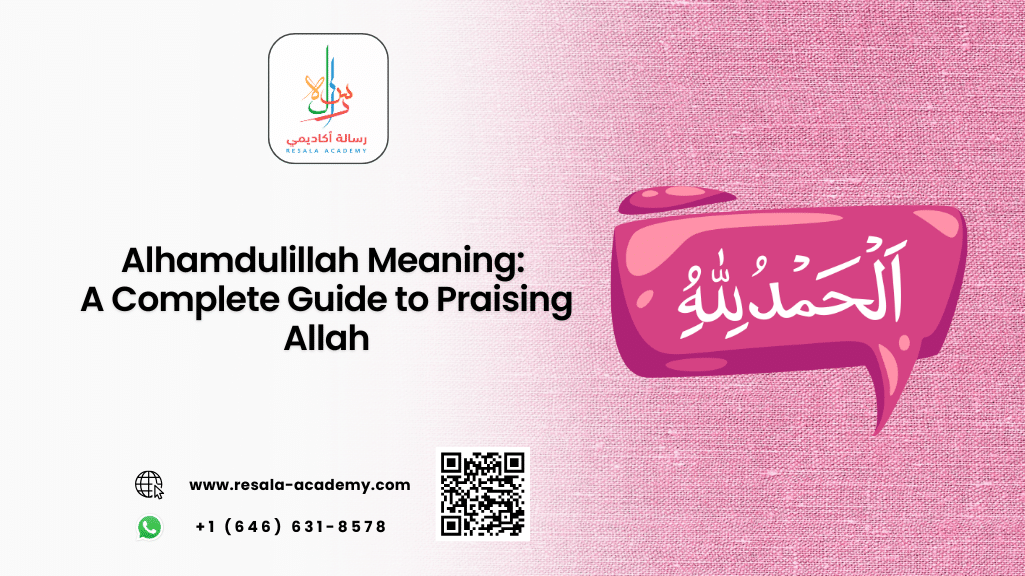
Alhamdulillah Meaning: A Complete Guide to Praising Allah
You may say it dozens of times every day — after a meal, upon waking, during every unit of prayer — yet have you ever paused to reflect on the true alhamdulillah meaning? This single phrase, spoken by over a billion Muslims worldwide, carries layers of linguistic beauty, theological depth, and spiritual power that a simple translation can never fully capture.
Understanding what “Alhamdulillah” truly means is not merely an academic exercise. It is a doorway into a deeper relationship with Allah, a richer experience in Salah, and a more grateful heart in every moment of life. Whether you are a new Muslim exploring foundational concepts or a lifelong believer seeking to deepen your connection with the Quran, grasping the full meaning of Alhamdulillah will transform the way you worship and live.
At Resala Academy, courses in Quran studies and Arabic language are designed to help non-native speakers unlock exactly this kind of profound understanding. You can explore all Quran courses at Resala Academy to begin that journey today.
What Does Alhamdulillah Mean in Arabic?
The phrase originates from the Arabic language and appears at the very opening of the Quran. Understanding its Arabic roots reveals far more than any single English word can convey.
The Linguistic Breakdown of Alhamdulillah
“Alhamdulillah” (الحمد لله) is composed of three essential parts. “Al” (ال) is the definite article, equivalent to “the” in English, but here it carries a meaning of totality and comprehensiveness — it refers to all praise, not merely some. “Hamd” (حمد) means praise accompanied by love, reverence, and acknowledgment of perfection. “Lillah” (لله) means “belongs to Allah,” combining the preposition “li” (for/to) with the name of God.
When these elements unite, the phrase means: “All praise and gratitude, in its entirety, belongs to Allah alone.” This is not a casual thank-you. It is a declaration that every form of commendation — for every blessing seen and unseen — is due exclusively to the Creator.
The Difference Between Hamd and Shukr
Many learners confuse “Hamd” (praise) with “Shukr” (thanks), but Arabic makes a meaningful distinction.
- Shukr is gratitude offered in response to a specific favor you have received.
- Hamd, on the other hand, is praise given to Allah for who He is — for His attributes of perfection, mercy, and majesty — whether or not you have personally received something.
This means that when you say “Alhamdulillah,” you are praising Allah both for what He has given you and for His inherent perfection. It is praise in times of ease and in times of hardship, which leads to one of the most powerful expressions in Islamic life: “Alhamdulillah ala kulli haal.”
Alhamdulillah Meaning in English: More Than “Thank God”
English translations often reduce “Alhamdulillah” to “Thank God” or “Praise be to God,” but these renderings miss critical nuances that shape a Muslim’s understanding.
Why “All Praise Is Due to Allah” Is the Closest Translation
The most accurate English rendering is “All praise is due to Allah.” This translation preserves three key elements: the comprehensiveness of “all,” the active acknowledgment of “praise,” and the exclusivity conveyed by “due to Allah.” Unlike “Thank God,” which can sound casual or reactive, “All praise is due to Allah” communicates a deliberate, reverent, and total act of worship.
For non-Arabic speakers learning the Quran, understanding this distinction enriches every prayer. Each time you recite Surah Al-Fatihah — which you do at least seventeen times a day across the five daily prayers — you open with this magnificent declaration.
The Spiritual Weight Behind Every Utterance
Saying “Alhamdulillah” is not merely a cultural habit. It is an act of worship that, when spoken with understanding and sincerity, carries immense reward. The Prophet Muhammad (ﷺ) taught that this phrase fills the scales of good deeds on the Day of Judgment. When you understand the meaning of Alhamdulillah, your daily utterances transform from routine words into conscious acts of devotion.
This is precisely why learning Arabic — even at a foundational level — changes a Muslim’s spiritual life. At Resala Academy, native Egyptian tutors guide students through the linguistic beauty of Quranic vocabulary, helping them move from surface-level recitation to heartfelt comprehension.
Alhamdulillah in the Quran and Sunnah
The phrase holds a central place in Islamic scripture. Its appearance at the very beginning of the Quran signals its supreme importance.
The Opening of the Quran: Surah Al-Fatihah
The second verse of Surah Al-Fatihah — the chapter every Muslim recites in every unit of prayer — declares:
Arabic: ٱلْحَمْدُ لِلَّهِ رَبِّ ٱلْعَـٰلَمِينَ
Translation: “[All] praise is [due] to Allāh, Lord1 of the worlds”
(Surah Al-Fatihah, 1:2 — Quran.com)
This verse establishes that praise belongs to Allah in His capacity as the Sustainer and Lord of all creation — not just of Muslims, but of every being in existence. It is a universal declaration of His sovereignty and perfection.
Additionally, in Surah Al-Baqarah (2:185), Allah speaks about the revelation of the Quran and concludes by encouraging believers to express gratitude:
Arabic: وَلِتُكَبِّرُوا۟ ٱللَّهَ عَلَىٰ مَا هَدَىٰكُمْ وَلَعَلَّكُمْ تَشْكُرُونَ
Translation: “And to glorify Allāh for that [to] which He has guided you; and perhaps you will be grateful.”
(Quran.com — 2:185)
Gratitude and praise are woven into the very fabric of Quranic guidance, reminding believers that every blessing — including the Quran itself — demands heartfelt acknowledgment.
The Prophet’s Teaching on the Power of Alhamdulillah
The Messenger of Allah (ﷺ) emphasized the weight of this phrase in numerous authentic narrations:
Arabic: الطُّهُورُ شَطْرُ الإِيمَانِ وَالْحَمْدُ لِلَّهِ تَمْلأُ الْمِيزَانَ
Translation: “Cleanliness is half of faith and al-Hamdu Lillah (all praise and gratitude is for Allah alone) fills the scale”
(Sahih Muslim 223 — Sunnah.com)
This hadith reveals the extraordinary spiritual weight of saying “Alhamdulillah” with sincerity. A phrase that takes less than a second to speak can fill an entire scale of good deeds — a profound incentive to say it often and with full awareness of what it means.
Alhamdulillah Subhanallah Allahu Akbar Meaning
These three phrases are often recited together as a form of dhikr (remembrance of Allah) and are among the most beloved words to Him.
Understanding Each Phrase Individually
- Alhamdulillah (الحمد لله) — “All praise is due to Allah.” An acknowledgment of Allah’s perfection and blessings.
- SubhanAllah (سبحان الله) — “Glory be to Allah.” A declaration that Allah is free from any imperfection, flaw, or deficiency.
- Allahu Akbar (الله أكبر) — “Allah is the Greatest.” An affirmation that Allah is greater than anything in creation, any worry, or any worldly attachment.
The Combined Power of These Phrases in Daily Dhikr
When recited together — especially after each of the five daily prayers — these three phrases form a comprehensive act of worship. You praise Allah for His blessings (Alhamdulillah), declare His absolute perfection (SubhanAllah), and affirm His supreme greatness (Allahu Akbar).
The Prophet (ﷺ) recommended reciting each phrase thirty-three times after every prayer, making this a practice that deepens mindfulness and spiritual presence throughout the day.
For learners who want to understand the Arabic behind these phrases and recite them with proper pronunciation, studying with qualified tutors makes a significant difference. Resala Academy’s online Arabic classes help students master not only pronunciation but also the meanings that bring these words to life.
Alhamdulillah Ala Kulli Haal Meaning
This extended phrase is a hallmark of a believer’s resilience and trust in Allah’s wisdom.
Praising Allah in Every Condition
“Alhamdulillah ala kulli haal” (الحمد لله على كل حال) translates to “All praise is due to Allah in every circumstance.” This expression is used when a Muslim faces difficulty, loss, or an outcome that is not what they hoped for. Rather than complaining or despairing, the believer responds with praise, trusting that Allah’s decree contains wisdom beyond human understanding.
How This Phrase Shapes a Muslim’s Character
Saying “Alhamdulillah ala kulli haal” is not about suppressing natural emotions. It is about anchoring your heart in the certainty that Allah’s plan is always good, even when it does not feel that way in the moment.
This practice cultivates patience (sabr), contentment (ridha), and an unshakeable trust in divine wisdom (tawakkul). It is one of the most beautiful expressions in the Arabic language and a cornerstone of Islamic spirituality.
Read more about: The Meaning of Salah and Salaam upon Prophet Muhammad PBUH
Specialized Insights for Non-Native Learners
Understanding Alhamdulillah more deeply requires awareness of how Arabic pronunciation and context shape its meaning.
Pronunciation and Grammar Tips
Arabic: الْحَمْدُ (Al-Hamdu)
Transliteration: Al-Ḥam-du
The letter “Ḥa” (ح) in “Hamd” is a deep, breathy sound produced from the throat. It is not the same as the English “H.” Mispronouncing it can alter the meaning entirely. This is one of the sounds non-native speakers benefit most from practicing with a native Arabic tutor.
Arabic: لِلَّهِ (Lillāhi)
Transliteration: Lil-lā-hi
The double “L” sound (lām) here carries specific rules in Tajweed — the science governing proper Quran recitation. When the name of Allah is preceded by a kasra vowel (as in “Lillāhi”), the lām is recited with lightness (tarqeeq). These nuances are exactly what students learn in Tajweed classes at Resala Academy, where native Egyptian tutors break down each sound with patience and precision.
Common Daily Contexts
After eating: A Muslim says “Alhamdulillah” to thank Allah for sustenance.
After sneezing: The Prophet (ﷺ) taught that one should say “Alhamdulillah,” and whoever hears it should respond with “Yarhamuk Allah” (May Allah have mercy on you).
Upon waking: Starting the day with “Alhamdulillah” acknowledges that every new morning is a gift from Allah.
Begin Your Journey to Understanding the Quran with Resala Academy
If reading about the alhamdulillah meaning has sparked a desire to understand more of what you recite every day, that desire is a gift worth acting on.
Resala Academy provides a supportive and effective learning environment built around the needs of non-Arabic speakers, with native Egyptian tutors, flexible one-on-one scheduling across all time zones, professional certification upon completing each level, and consistently top-rated reviews on both Google and Trustpilot.
Your first step costs nothing. Book your free trial class at Resala Academy and experience what it feels like to learn Arabic and Quran with teachers who care about your growth as much as you do.
Frequently Asked Questions
What does Alhamdulillah mean in English?
“Alhamdulillah” translates to “All praise is due to Allah.” It is a comprehensive expression of praise and gratitude directed exclusively to Allah for His blessings, attributes, and perfection. It carries far more depth than the common English phrase “Thank God.”
When should a Muslim say Alhamdulillah?
Muslims are encouraged to say “Alhamdulillah” throughout the day — after eating, upon waking, after sneezing, when receiving good news, and even during hardship. It is also recited in every unit of the five daily prayers as part of Surah Al-Fatihah.
What is the difference between Alhamdulillah and SubhanAllah?
“Alhamdulillah” is praise and gratitude to Allah for who He is and what He gives. “SubhanAllah” declares Allah’s perfection and freedom from any flaw. Both are forms of dhikr but serve different spiritual purposes.
Can I learn the deeper meaning of Quranic phrases online?
Absolutely. Online academies like Resala Academy offer structured courses in Quranic Arabic, Tajweed, and Quran translation that help non-native speakers understand the meaning behind what they recite. One-on-one sessions with native tutors make learning personalized and effective.
What does Alhamdulillah ala kulli haal mean?
It means “All praise is due to Allah in every circumstance.” Muslims say this during difficult times as an expression of trust in Allah’s wisdom, recognizing that His plan is always good even when outcomes feel challenging.
Conclusion
The meaning of Alhamdulillah extends far beyond a simple “thank you” to God. It is a declaration of total, loving, reverent praise — an acknowledgment that every blessing, every breath, and every moment of existence is sustained by Allah alone.
When you understand what Alhamdulillah truly means, your prayers become more present, your gratitude becomes more sincere, and your relationship with the Quran becomes profoundly personal.
This understanding begins with learning. At Resala Academy, non-native speakers from around the world are guided by experienced native Egyptian tutors through the beauty of Arabic and the wisdom of the Quran — from the very first letter to the deepest layers of meaning. Let every “Alhamdulillah” you speak be one you truly feel.